IMilan, the 1440s
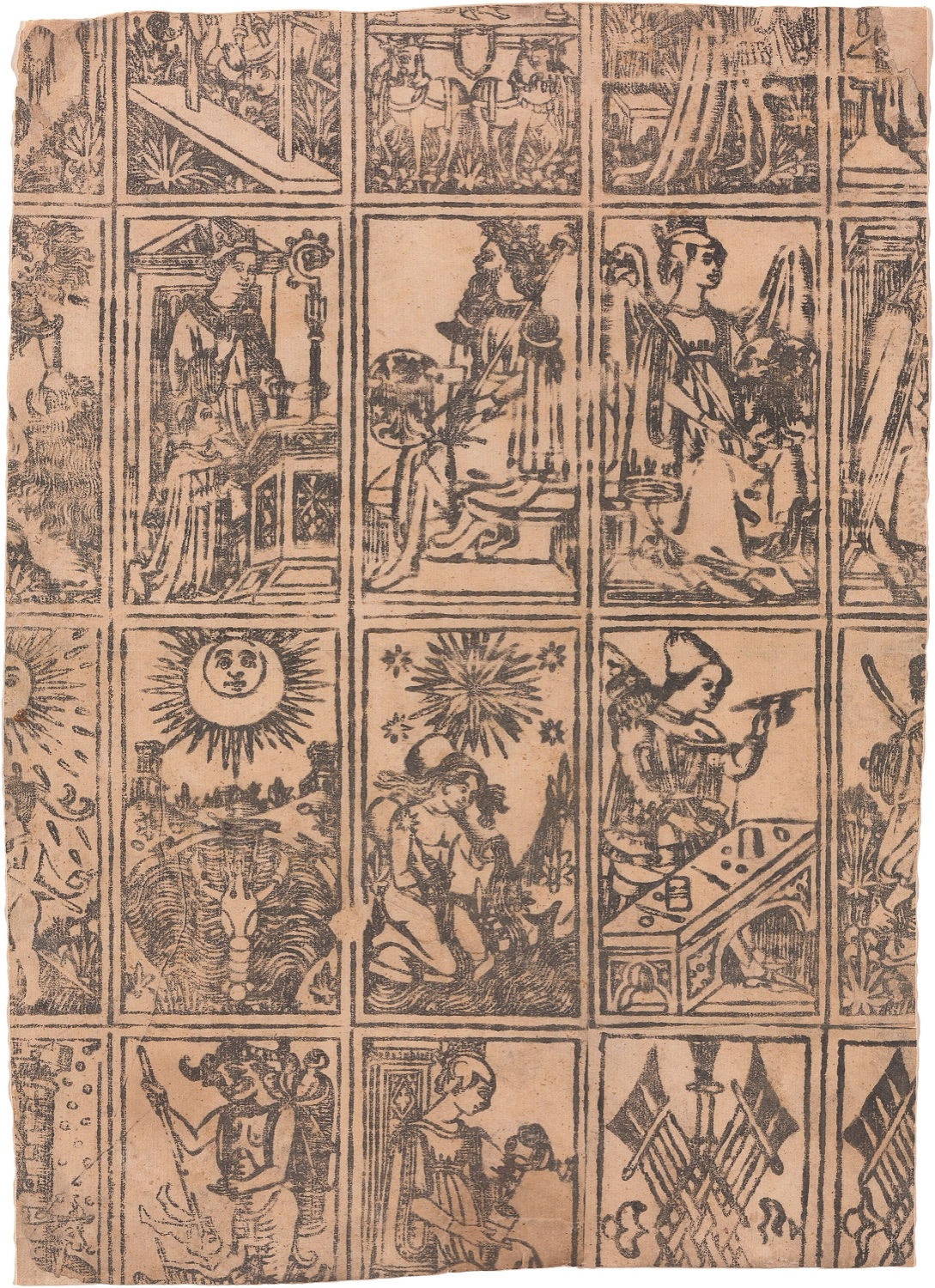
Playing cards reached Europe from the Islamic world in the 1370s, in four suits of cups, coins, swords and polo sticks that became batons. Some time before 1440, at the courts of northern Italy, somebody added a fifth series of allegorical picture cards that outranked the others, and called them trionfi, triumphs. The game played with them was a trick-taking game in which these picture cards served as permanent trumps. That is all the tarot was for its first three hundred years, and in France, Austria and Italy it is still played that way.
The earliest surviving decks are hand-painted luxury objects made for the Visconti and Sforza dukes of Milan in the mid-fifteenth century, gold leaf and tempera on pasteboard, attributed in part to the painter Bonifacio Bembo. No complete set survives; the cards are scattered among the Morgan Library, the Accademia Carrara in Bergamo and private collections. By the sixteenth century the game was called tarocchi, of unknown etymology, and cheap woodblock-printed decks were sold across Italy and into France and Switzerland.
The iconography is that of a Christian and courtly Renaissance: the virtues, the Wheel of Fortune, Death, the Last Judgement, the Pope and Emperor, the triumphal procession of Petrarch's poem. There is no Egyptian, Hebrew or occult element in any early deck, and no evidence of divinatory use before the eighteenth century beyond a handful of poetic games assigning characters to courtiers.
IIThe Tarot de Marseille
By the seventeenth century a standard pattern had settled among the card-makers of France, centred on Marseille and Lyon: twenty-two trumps including the unnumbered Fool, fifty-six suit cards in four suits of bâtons, coupes, épées and deniers, and a court of valet, cavalier, reine and roi. The decks of Jean Noblet around 1650, Jean Dodal around 1701 and Nicolas Conver in 1760 are its great exemplars, and the Conver pattern is the one most modern "Marseille" decks copy.
| No. | Marseille | English / modern |
|---|---|---|
| 0 | Le Mat | The Fool |
| I | Le Bateleur | The Magician |
| II | La Papesse | The High Priestess |
| III | L'Impératrice | The Empress |
| IIII | L'Empereur | The Emperor |
| V | Le Pape | The Hierophant |
| VI | L'Amoureux | The Lovers |
| VII | Le Chariot | The Chariot |
| VIII | La Justice | Strength (VIII in the Golden Dawn order) |
| VIIII | L'Hermite | The Hermit |
| X | La Roue de Fortune | Wheel of Fortune |
| XI | La Force | Justice (XI in the Golden Dawn order) |
| XII | Le Pendu | The Hanged Man |
| XIII | (unnamed) | Death |
| XIIII | Tempérance | Temperance |
| XV | Le Diable | The Devil |
| XVI | La Maison Dieu | The Tower |
| XVII | L'Étoile | The Star |
| XVIII | La Lune | The Moon |
| XVIIII | Le Soleil | The Sun |
| XX | Le Jugement | Judgement |
| XXI | Le Monde | The World |
IIIParis, 1781: The Invention of the Egyptian Tarot
In 1781 Antoine Court de Gébelin, a Protestant pastor, Freemason and scholar of the primitive world, published the eighth volume of his vast Le Monde primitif. In it he recounted that, visiting a lady in Paris, he had seen the tarot being played and recognised at once that the trumps were not a game but the surviving pages of the Book of Thoth, the lost wisdom of the Egyptian priests, disguised as cards to survive the burning of the temples. Tarot, he explained, came from Egyptian tar, road, and ro, king. In the same volume an essay by the Comte de Mellet linked the twenty-two trumps to the twenty-two letters of the Hebrew alphabet and described a method of reading them.
None of it was true, and it could not be known to be untrue until Jean-François Champollion deciphered the hieroglyphs in 1822, at which point it was simply ignored. The Egyptian tarot is a Parisian invention of 1781, and every claim of the tarot's antiquity descends from it.
A wig-maker and print dealer named Jean-Baptiste Alliette, who reversed his name as Etteilla, had already published a method of card divination in 1770 and seized on Court de Gébelin's theory. He published a book on reading the tarot in 1785, founded a society for its study, and around 1789 issued the first deck designed specifically for divination, with the trumps rearranged to fit his account of Egyptian cosmology.
IVLévi, Papus and the Golden Dawn
Éliphas Lévi in 1856 took the Comte de Mellet's idea and made it the key to all occultism: the twenty-two trumps are the twenty-two Hebrew letters, which are the twenty-two paths of the Kabbalistic Tree, and the tarot is therefore a universal alphabet of the esoteric tradition. He assigned the Fool, awkwardly, to the letter shin, next to last. Papus, Gérard Encausse, wrote Le Tarot des Bohémiens in 1889, and Oswald Wirth published a redesigned occult Marseille deck the same year.
The Golden Dawn reordered Lévi's attributions, putting the Fool at the beginning on aleph, and swapped the positions of Strength and Justice so that Strength fell on the path of Leo and Justice on Libra. Its members made their own decks by hand, copying a master set said to have been drawn by Mathers and his wife Moina. Every modern occult tarot descends from that Golden Dawn system.
VLondon, 1909
In 1909 the publisher William Rider and Son issued a deck designed by Arthur Edward Waite, a scholarly and cantankerous former member of the Golden Dawn, and drawn by Pamela Colman Smith, an American illustrator and stage designer in the same circle. It followed the Golden Dawn order with Strength as VIII and Justice as XI. Its revolution was in the minor arcana: where the Marseille pips showed only arrangements of suit symbols, Smith drew a scene for every one of the fifty-six cards, the man carrying seven swords from a camp, the three women raising cups, the figure on the ten of swords. She had seen photographs of the illustrated fifteenth-century Sola Busca deck at the British Museum in 1907.
Waite's Pictorial Key to the Tarot accompanied it. Smith was paid a flat fee and received no royalties; the deck, long called the Rider-Waite, is increasingly and properly called the Rider-Waite-Smith, and it is the pattern of the great majority of tarot decks printed since.
The other great deck of the twentieth century is Aleister Crowley's Thoth Tarot, painted to his exhaustive instructions by Lady Frieda Harris between 1938 and 1943 and accompanied by his Book of Thoth of 1944. Both died in the 1940s; the deck was not published until 1969.
VIHow a Reading Works
A deck of seventy-eight cards gives seventy-eight to the power of ten, times the chance of reversals, possible ten-card readings, which is to say effectively infinite. The reader lays the cards in a spread whose positions give each card a context, the past, the obstacle, the outcome, and then does something that is hard to describe and easy to recognise: builds a story in which the images and the querent's situation illuminate each other. The Celtic Cross spread was published by Waite; the three-card spread is the oldest and simplest.
What happens in a reading has been explained as chance, as cold reading, as synchronicity in Jung's sense, and as a structured prompt to the reader's and querent's own intuition. The last is the explanation most working readers now give themselves. The images repay study on any account, and a good deck is a gallery of Renaissance and occult iconography in the palm of the hand.