IThe Omens of Babylon
Astrology began as a branch of divination for kings. The Mesopotamian scribes who compiled the great omen series Enuma Anu Enlil, seventy tablets and some seven thousand omens assembled over the second millennium BC, were not casting horoscopes for individuals. They were watching eclipses, the risings of Venus and the colours of the moon for signs about the king, the harvest and war, because the gods wrote on the sky as a scribe writes on clay. If the moon is eclipsed in the month of Nisan and the north wind blows, the king of Akkad will die.
Two innovations of the first millennium turned omens into astrology. The first was mathematical: by the eighth century BC the astronomers of Babylon were keeping continuous records of planetary positions, the Astronomical Diaries, which ran for some seven hundred years and allowed them to predict the planets rather than merely observe them. The second was the zodiac of twelve equal signs of thirty degrees, which appears in cuneiform around the fifth century BC. The oldest horoscope known, a cuneiform tablet for a child born in 410 BC, gives the positions of the moon and planets at the birth, and the individual nativity is born with it.
IIThe Hellenistic Horoscope
What is now called astrology, the chart with its houses, aspects, lots and rulers, was invented in Hellenistic Egypt in the second and first centuries BC by fusing Babylonian planetary mathematics with Egyptian decans and Greek philosophy. Its early authorities wrote under the names of Nechepso and Petosiris, a pharaoh and a priest, and of Hermes himself. The ascendant, the degree rising on the eastern horizon at birth, became the pivot of the chart, and from it twelve places or houses were counted, each governing a department of life.
The two great surviving handbooks come from the second century AD. Claudius Ptolemy, the astronomer of Alexandria, wrote the Tetrabiblos, which grounded astrology in Aristotelian physics: the planets act by heating, cooling, drying and moistening, as the sun plainly does, and astrology is therefore a natural science of probabilities, not a fate. Vettius Valens wrote the Anthology, a practitioner's casebook full of real charts and techniques Ptolemy disdained. The tension between them, the philosopher's astrology of physical influence and the working astrologer's astrology of signs and lots, has never been resolved.
IIIBaghdad and Toledo
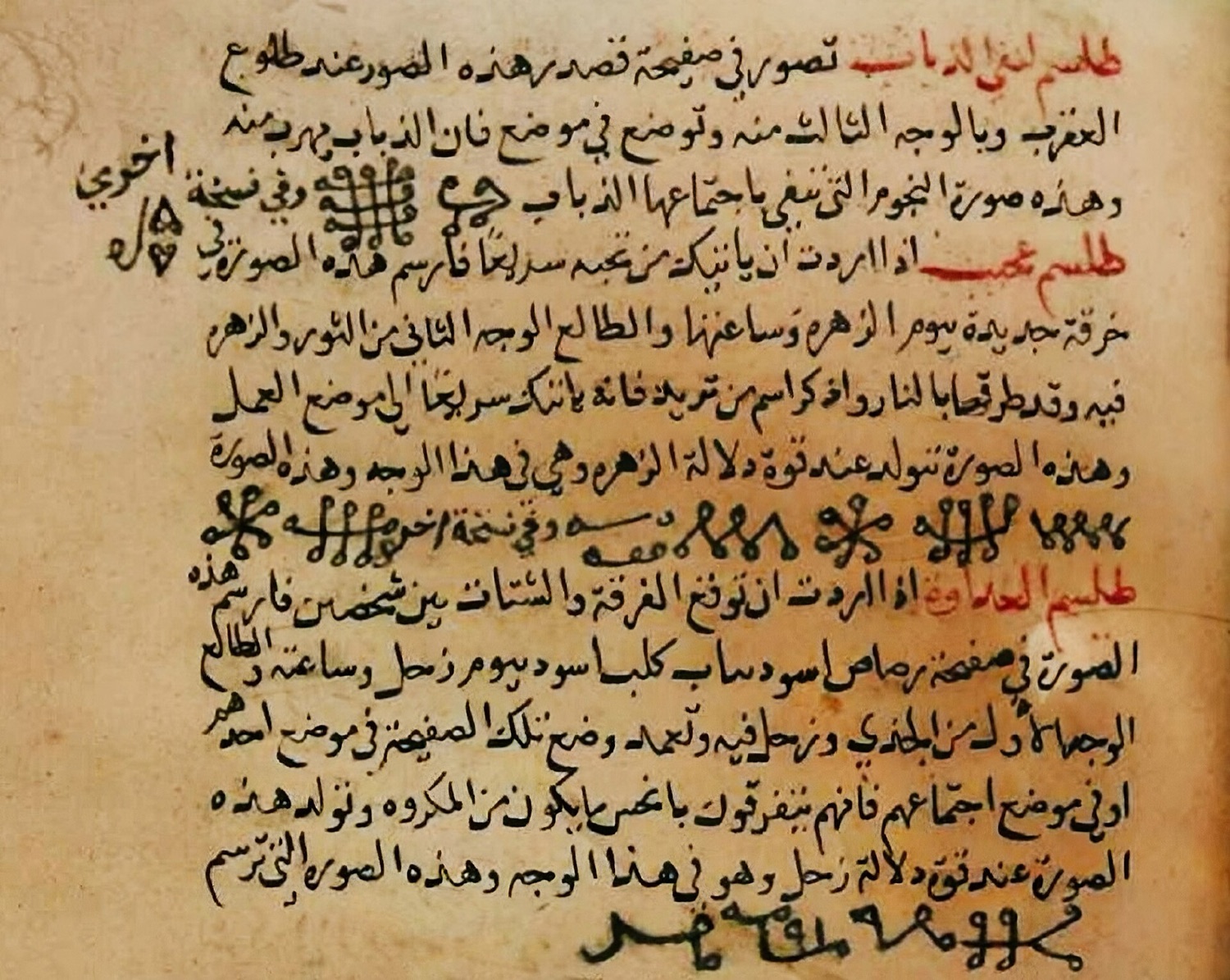
When the Abbasid caliphs founded Baghdad in 762 its foundation stone was laid at a moment chosen by astrologers, one of them the Persian Jew Mashallah. Over the next two centuries the astrologers of the Islamic world translated the Greek, Persian and Indian material and built on it. Abu Ma'shar of Balkh, who died in 886, wrote the Great Introduction and a theory of history driven by the conjunctions of Jupiter and Saturn, which recur every twenty years and shift triplicity every two hundred and forty. Al-Kindi wrote on the rays of the stars as a physical force. Al-Biruni wrote the most learned astrological textbook of the medieval world, and the Picatrix built a whole magic on celestial images.
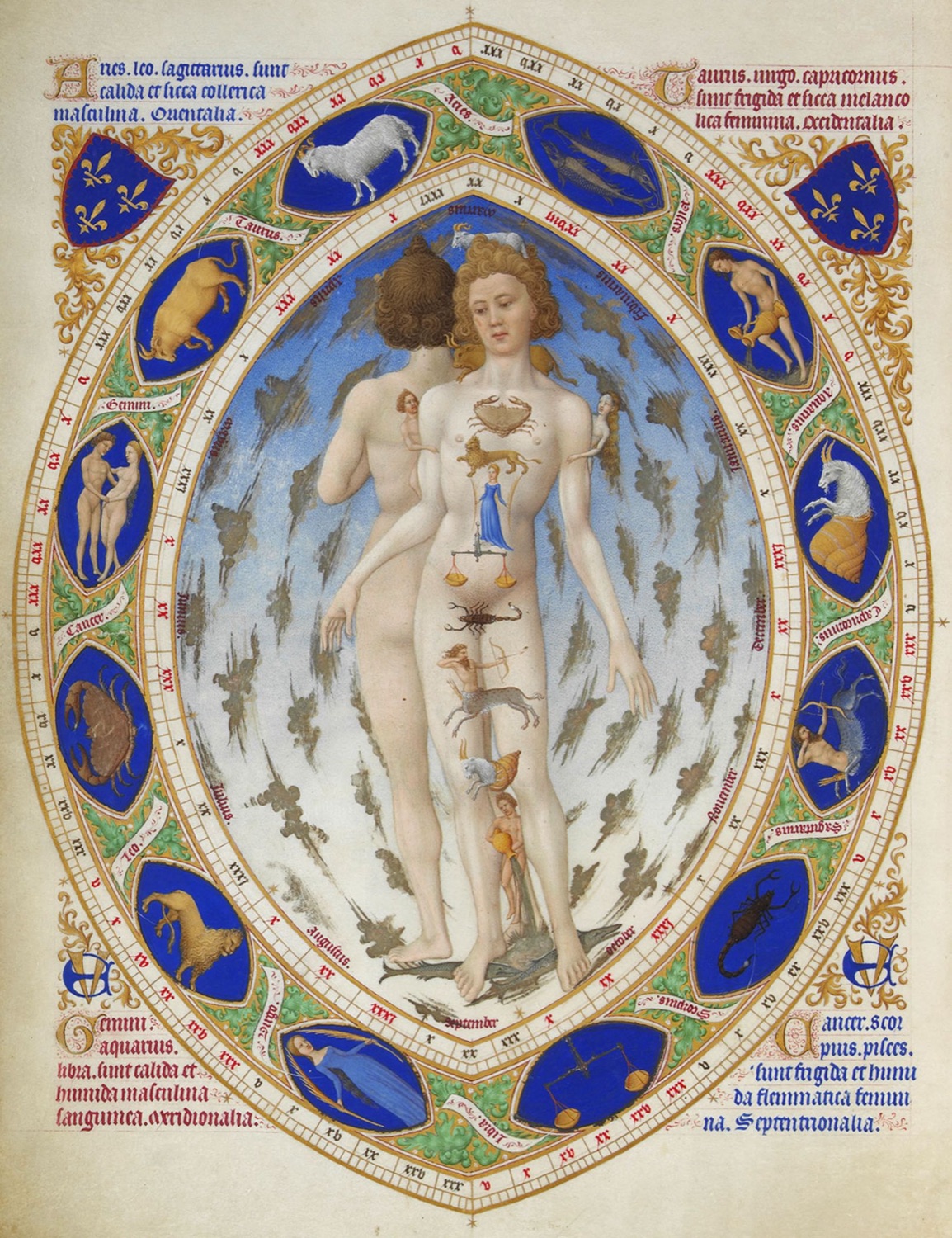
Translated in Toledo and Sicily in the twelfth century, this Arabic astrology became the astrology of the Latin West. It was taught in the medieval universities as part of medicine, since the physician needed to know the moon's sign before bleeding a patient, and the zodiac man mapping the signs onto the body hung in every physician's almanac. Guido Bonatti, astrologer to the Ghibelline lord of Forlì in the thirteenth century, is in Dante's Inferno with his head on backwards.
IVWilliam Lilly and the Horary Question
English astrology reached its height in the Civil War. William Lilly published Christian Astrology in 1647, the first comprehensive astrology textbook in English, eight hundred pages that are still in print and still used. His speciality was horary astrology: a chart cast not for a birth but for the moment a question is asked and understood by the astrologer, and read to answer that question. Will the ship return? Where is the stolen spoon? Is the king in Oxford? Lilly's almanacs sold thirty thousand copies a year, and in 1666 he was summoned before a committee of the House of Commons to explain how he had foreseen the Great Fire of London in a hieroglyphic published fifteen years earlier. He was thanked and dismissed.
Within fifty years educated astrology had collapsed. Not refuted, exactly: the Copernican cosmos did not disprove it, and Kepler cast horoscopes for a living. It simply lost its place in the universities and in the conversation of gentlemen, and survived in almanacs for farmers and the poor.
VThe Revival and the Column
The modern revival came through Theosophy. Alan Leo, a member of the Theosophical Society, reinvented astrology in the 1890s as a map of character and spiritual evolution rather than of events, simplified its techniques for mass publication, and was prosecuted twice for fortune-telling. The psychological astrology of the twentieth century, above all Dane Rudhyar and later Liz Greene, grew from his work and from Jung's interest in it.
The sun-sign column has an exact birthday. On 24 August 1930 the London Sunday Express ran a horoscope for the newborn Princess Margaret by R. H. Naylor, who predicted an eventful life. When the R101 airship crashed that October and Naylor was credited with foreseeing trouble for British aircraft, the paper gave him a regular feature, and to make it apply to every reader he divided it by the twelve signs of the sun. Astrologers of every school have despised it since, and it is the only astrology most people have ever read.
VIThe Argument
Two objections every astrologer should be able to answer, and one experiment every sceptic should know the details of.
Precession. The earth's axis wobbles, and the point of the spring equinox slides backwards through the constellations about one degree every seventy-two years. Western astrology uses the tropical zodiac, in which Aries begins at the spring equinox whatever stars lie behind it; the constellations and the signs have drifted apart by roughly twenty-four degrees since Ptolemy. Indian jyotisha uses the sidereal zodiac fixed to the stars. Tropical astrologers reply, correctly, that their signs were always seasonal divisions and were never the constellations; the objection is sound against the column and unsound against the tradition.
The mechanism. There is no known force by which the planets could shape a character, and the gravitational pull of the midwife exceeds that of Mars. Ptolemy's physical astrology is dead. Many modern astrologers answer that astrology works by correspondence or synchronicity rather than causation, which is a coherent position but moves the claim outside what an experiment can test.
The tests. In 1985 the physicist Shawn Carlson published in Nature a double-blind experiment in which astrologers chosen by their own professional body tried to match natal charts to personality profiles; they did no better than chance. Michel Gauquelin's statistical work of the 1950s onward is the best known result on the other side: a small excess of eminent sports champions born with Mars just past the rising or culminating point. The "Mars effect" survived several attempted refutations and failed others, and the argument over the data and the handling of it is still unresolved among the few who have read it closely.
VIIThe Planetary Hours
One piece of astrology everyone uses without knowing it. The ancient Chaldean order places the seven visible planets by their apparent speed: Saturn, Jupiter, Mars, the Sun, Venus, Mercury, the Moon. Assign each hour of the day to a planet in that order, and the planet ruling the first hour of each day gives the day its name. That is why the week runs as it does, and why Saturday is Saturn's day and Monday the moon's. Talismanic magic is timed by the same hours, divided unequally between daylight and night according to the season and the latitude.
| Day | Planet | Metal |
|---|---|---|
| Sunday | Sun | gold |
| Monday | Moon | silver |
| Tuesday | Mars | iron |
| Wednesday | Mercury | quicksilver |
| Thursday | Jupiter | tin |
| Friday | Venus | copper |
| Saturday | Saturn | lead |