IThe Difference
Every shop selling these objects uses the two words interchangeably, and they should not. An amulet is protective and essentially passive: it wards off. It works by what it is or what it depicts, the eye that turns back the evil eye, the hand held up against it, the knot that binds. Pliny the Elder already uses the Latin amuletum for such objects in the first century. A talisman is made: a figure, seal or inscription produced at the correct time in the correct material by a prescribed rite, to attract a specific power or influence to its owner. The word comes through Arabic ṭilasm from late Greek telesma, a completion, a consecration.
The distinction blurs at the edges, and I would rather state that than pretend otherwise. An Egyptian scarab is inscribed and consecrated but protects. A Solomonic pentacle can defend or command. But the difference in principle is real, and it is the difference between a charm you are given and one that someone had to make in an hour that will not come again for a week.
IIThe Evil Eye
The single most widespread belief served by amulets is the evil eye: the idea that envy, conveyed by a look, can harm a child, a beast, a harvest or a fortune. It is attested in Sumerian incantations, in the Hebrew Bible's ʿayin hara, in Greek as baskania and in Latin as fascinatio, from which English inherits fascinate. The Romans hung a bronze phallus, the fascinus, round children's necks and on the gates of towns against it; the logic was that an obscene or startling object catches the envious glance and discharges it.
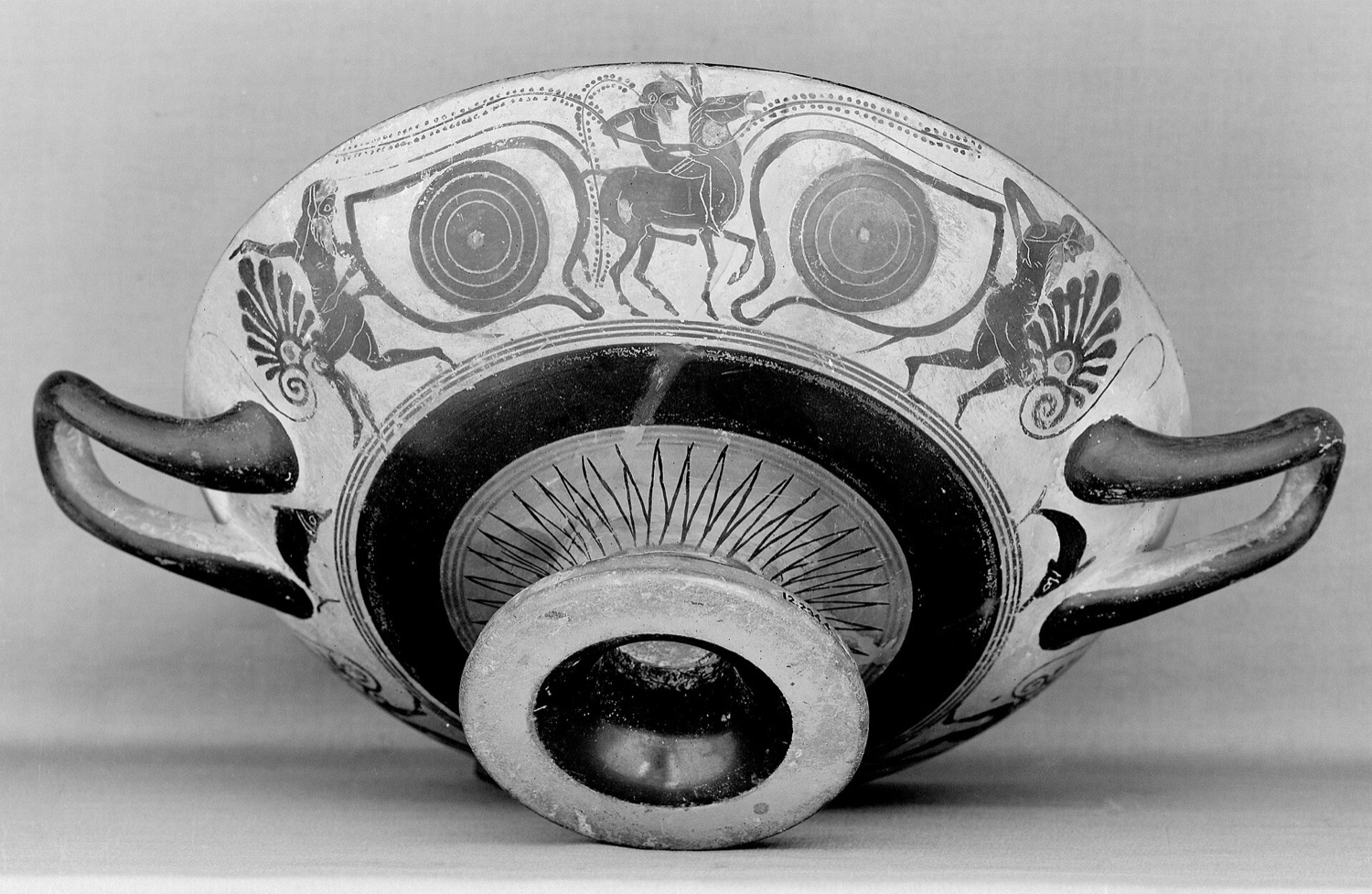
The great family of eye-amulets works by the same principle turned round: an eye is set to look back. The Attic eye-cup of the sixth century BC, the blue glass nazar sold in every Turkish and Greek market today, and the eye painted on the prows of Mediterranean fishing boats are one idea across two and a half thousand years. The hamsa, the open right hand, shared by Jewish households as the hand of Miriam and Muslim ones as the hand of Fatima, raises a palm against it.

IIIEgypt: The Amulet Civilisation
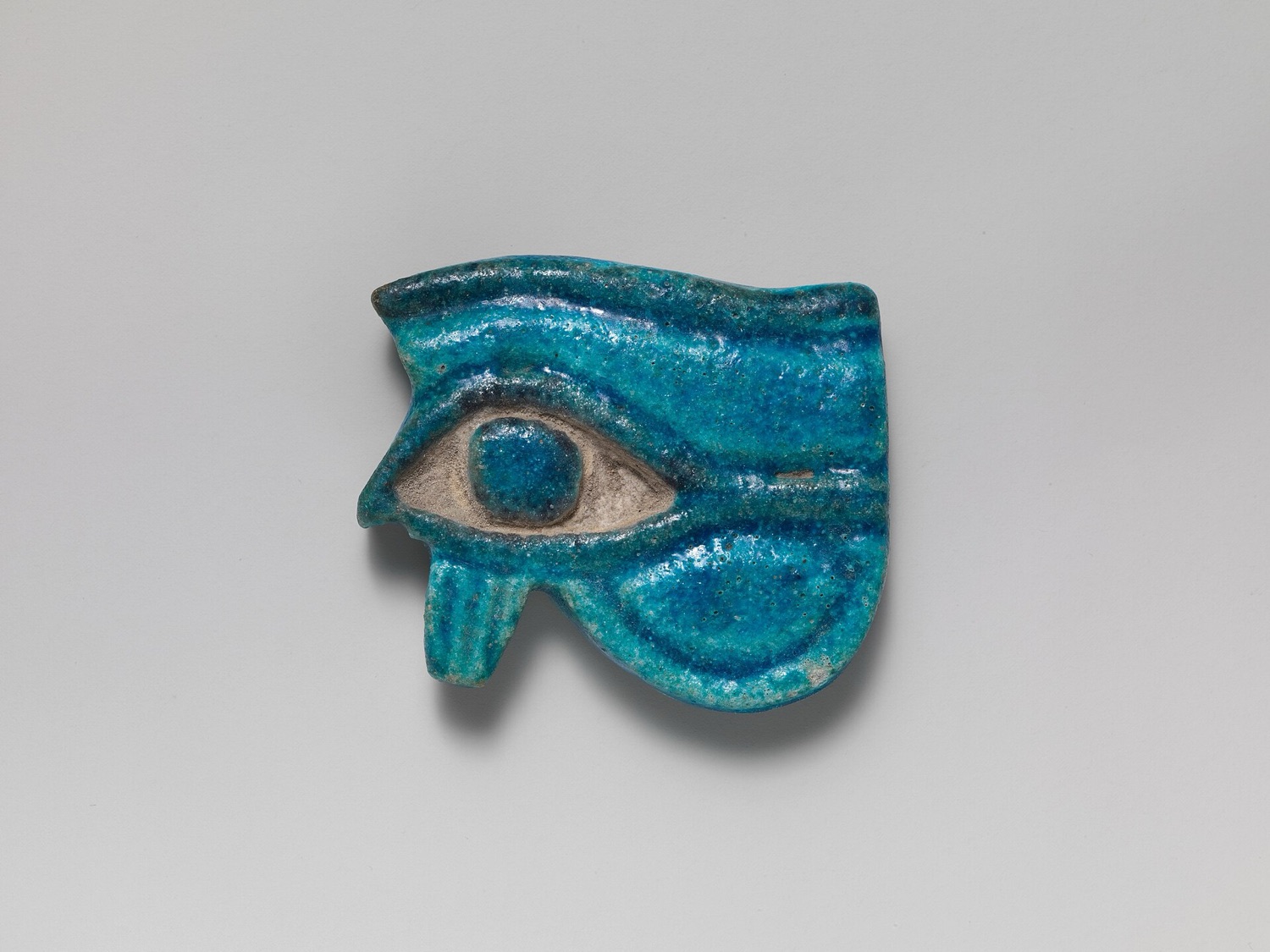
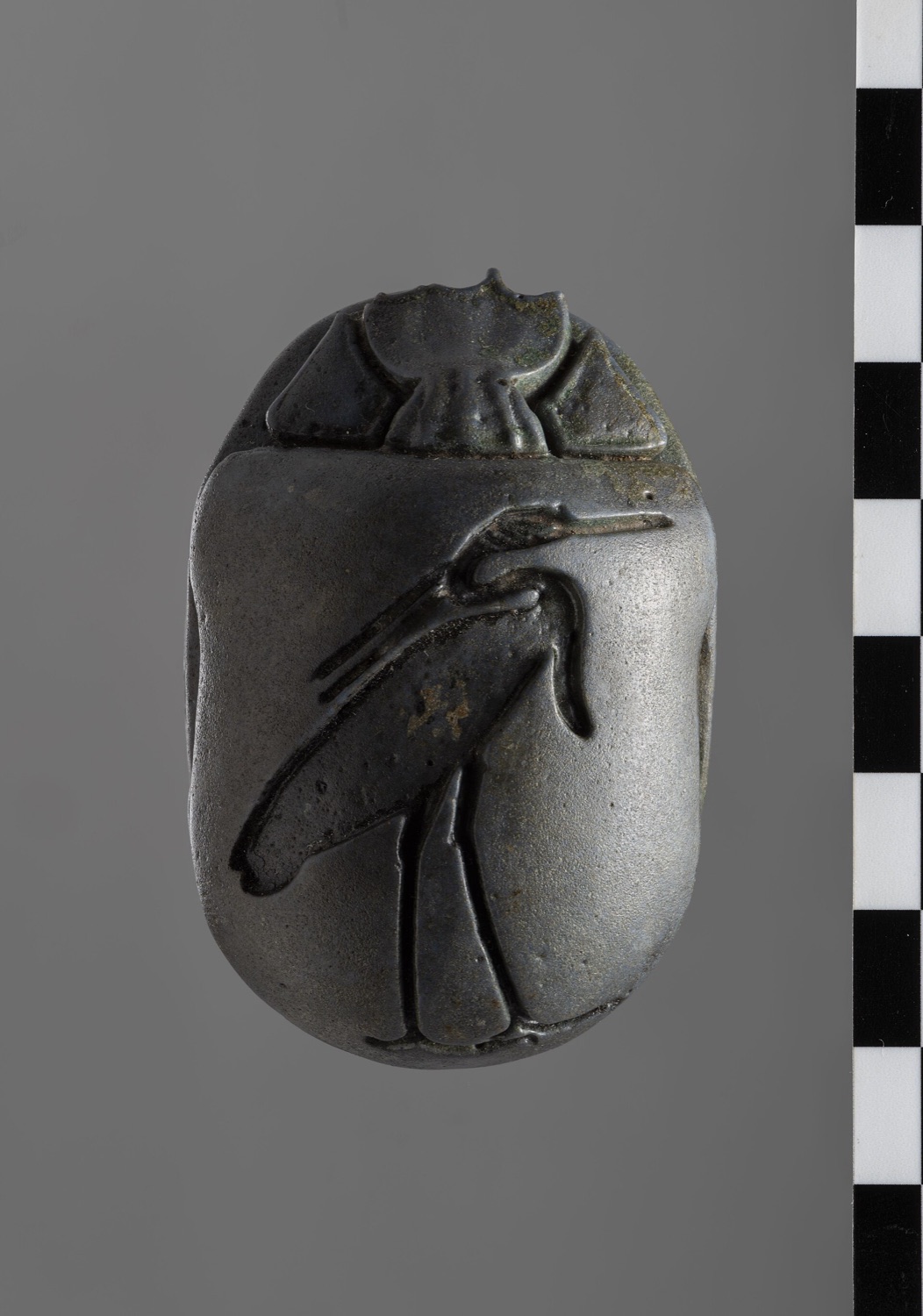
No culture made more amulets than Egypt, and none took them further into death. The wedjat, the eye of Horus torn out by Seth and restored by Thoth, meant wholeness and was the commonest amulet of the ancient world. The scarab, the dung beetle rolling the sun, meant becoming; the heart scarab, placed over the heart of the mummy and inscribed with Spell 30B of the Book of the Dead, commanded the heart not to testify against its owner when it was weighed against the feather of truth. The djed pillar was the backbone of Osiris, the tyet the knot of Isis, the ankh life itself. Funerary papyri prescribe exactly which amulets go where among the bandages, and Tutankhamun's mummy was wrapped with more than a hundred and forty.
IVThe Written Word as Amulet
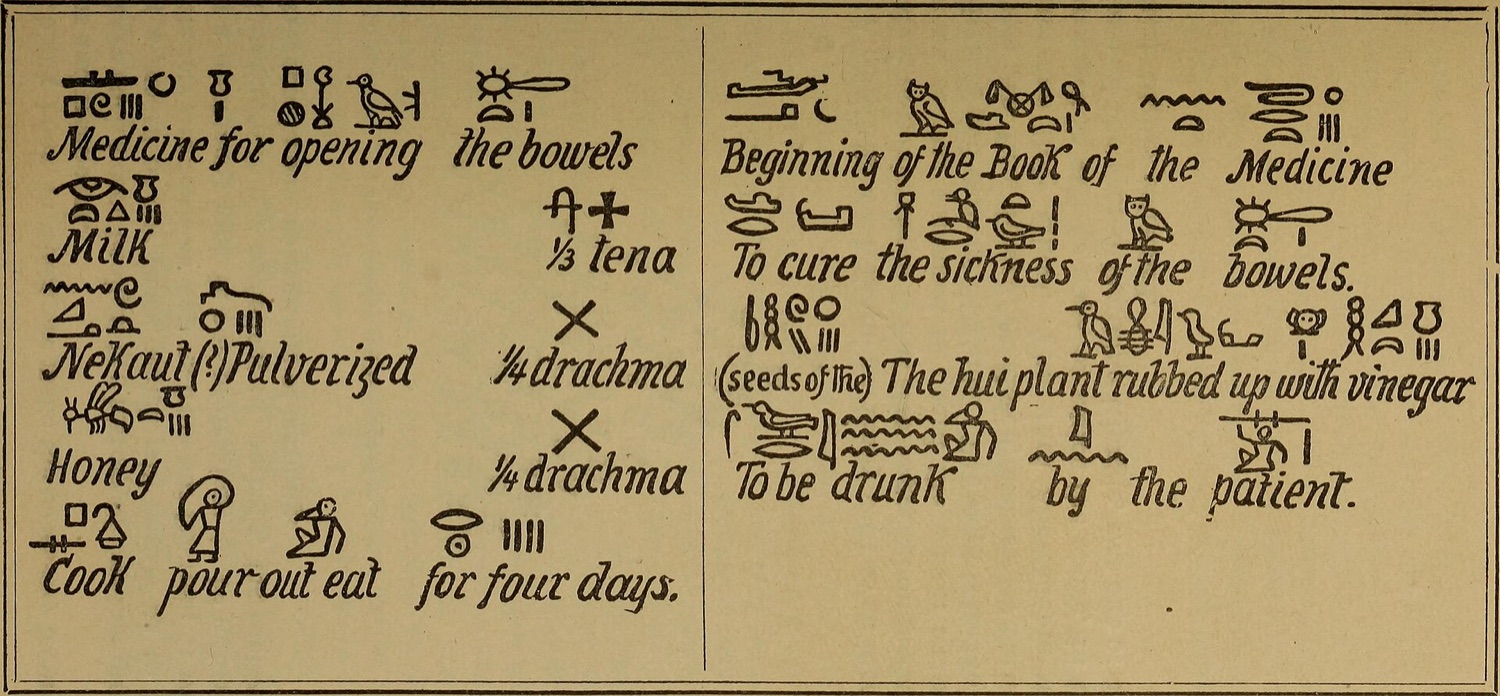
Where writing is sacred, writing protects. Deuteronomy commands that the words of the Shema be bound as a sign upon the hand and between the eyes and written on the doorposts, and Jewish practice has kept both the tefillin, the phylacteries with their parchment scrolls, and the mezuzah on the doorpost for more than two thousand years. Muslim amulets carry verses of the Qur'an, especially the Throne Verse, in cases worn on the body. Christian Europe wore Gospel texts, relics and the names of the Magi.
Two of the oldest word-amulets are puzzles. ABRACADABRA first appears in the Liber medicinalis of Quintus Serenus Sammonicus in the third century, written in an inverted triangle that loses a letter each line, as a cure for fever that should shrink as the word does; its etymology is unknown. The SATOR square, SATOR AREPO TENET OPERA ROTAS, reads the same in four directions and was scratched on a column at Pompeii before the eruption of AD 79. Its letters rearrange into a cross of PATERNOSTER with A and O, alpha and omega, left over, which has suggested a Christian origin; its presence at Pompeii makes that hard to accept, and the question is open.
VThe Magic Squares
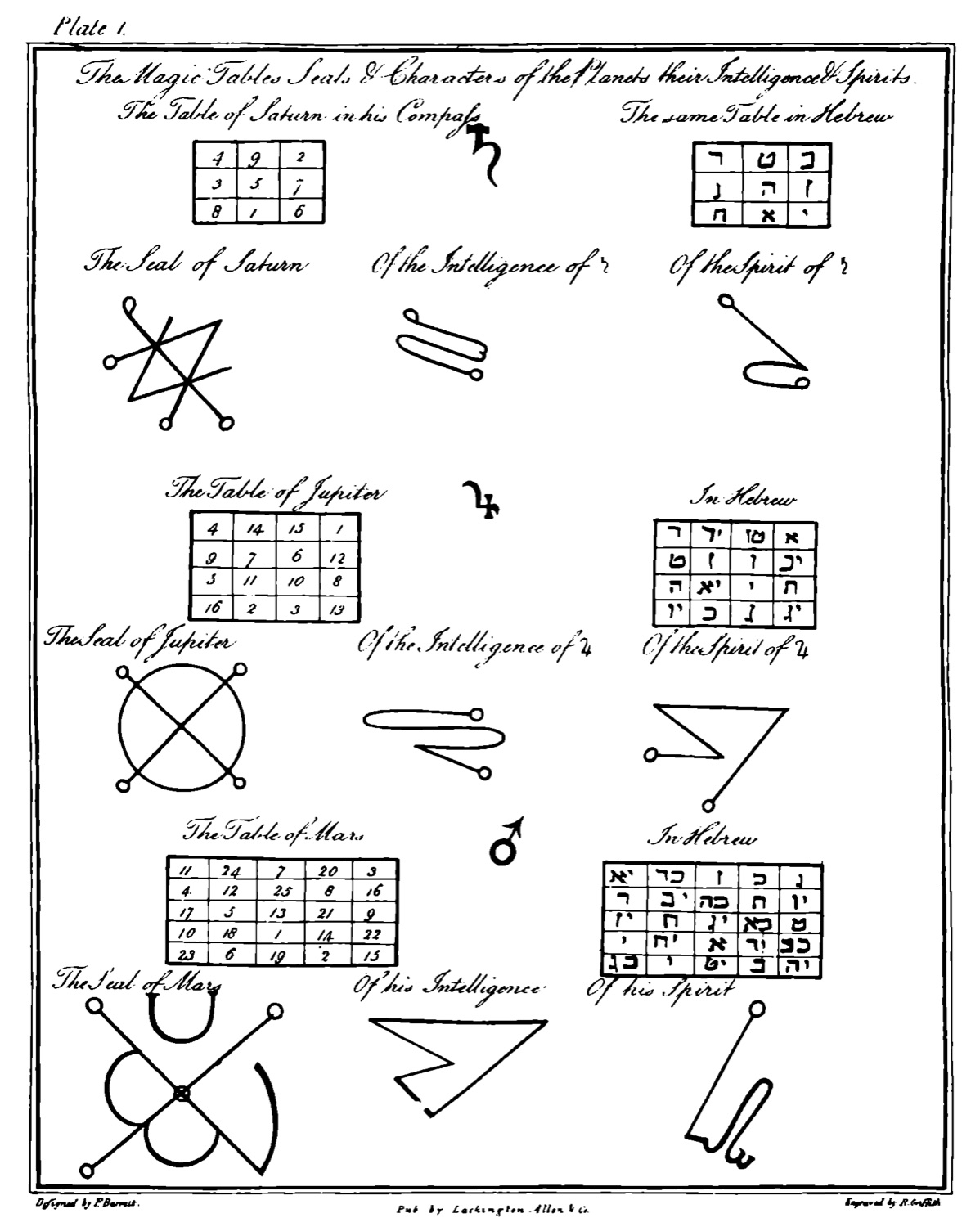
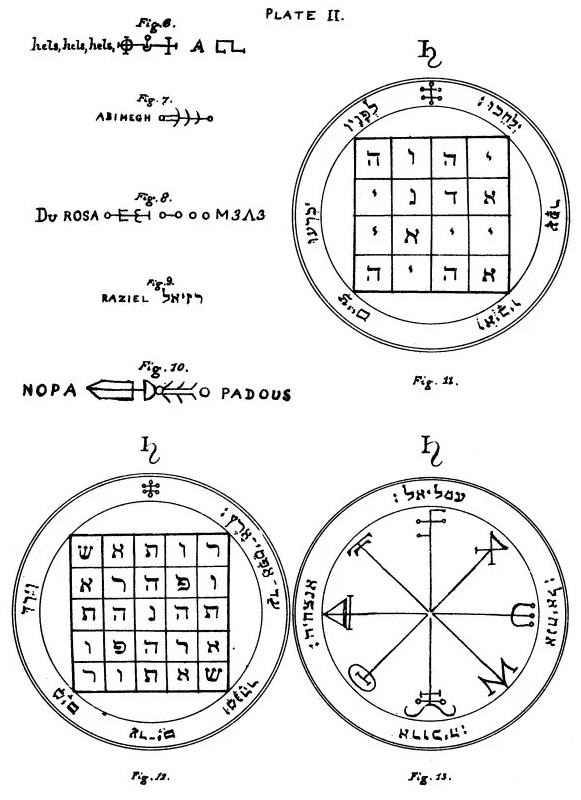
A magic square is a grid of numbers in which every row, column and diagonal sums to the same total. Chinese legend has the Lo Shu, the three-by-three square, appearing on the shell of a turtle emerging from the river Luo in the time of the emperor Yu. Arabic mathematicians were constructing squares of higher orders by the tenth century and inscribing them on amulets. In the West they entered magic through the Arabic astral tradition and were fixed for good by Agrippa, who assigned seven squares to the seven planets in the second book of the Occult Philosophy, each with its metal, its intelligence and its spirit, whose names and seals are derived from the square itself by converting letters to numbers and tracing lines across the grid.
| Planet | Square | Line sum | Metal |
|---|---|---|---|
| Saturn | 3×3 | 15 | lead |
| Jupiter | 4×4 | 34 | tin |
| Mars | 5×5 | 65 | iron |
| Sun | 6×6 | 111 | gold |
| Venus | 7×7 | 175 | copper |
| Mercury | 8×8 | 260 | quicksilver alloy |
| Moon | 9×9 | 369 | silver |
Albrecht Dürer put the square of Jupiter, the traditional cure for the melancholy of Saturn, on the wall behind the brooding angel of his engraving Melencolia I of 1514, with the date in the bottom row. The whole method of drawing a planetary sigil from a name across its square is set out, and can be run in your browser, at the house of Talismans below.
VIThe Pentacles of Solomon
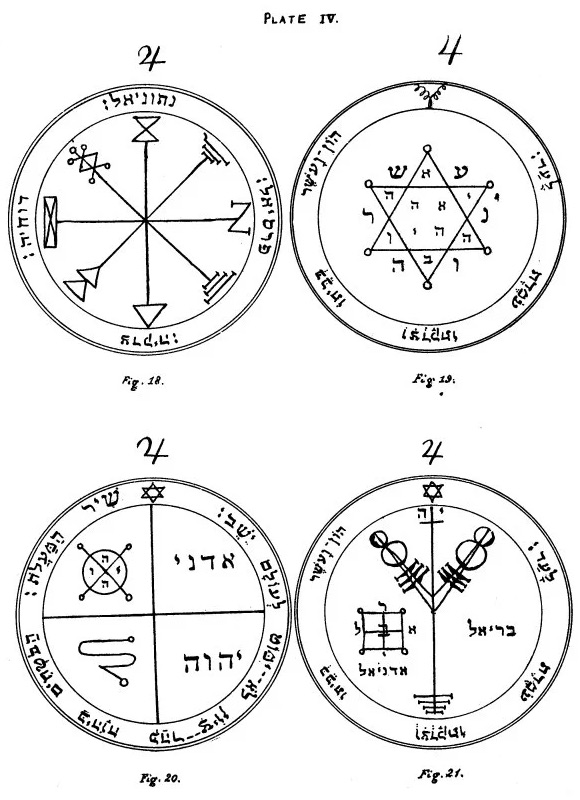
The Key of Solomon contains forty-four pentacles, seven sets for the seven planets, each a circular figure combining divine names, angelic seals, Hebrew letters and a verse of Scripture, and each with a stated power: to discover treasure, to win favour, to cause earthquakes, to protect against every danger of the journey. They were to be drawn on virgin parchment or engraved in the planetary metal, in the day and hour of the planet, with the moon waxing, after the operator's purification. MacGregor Mathers published them from the manuscripts in the British Museum in 1888, and they have been the most copied talismans in the West since.
These are exact objects. Their value, for anyone who uses them, depends on their being correct: the right names, spelt as the manuscripts spell them, in the right metal. That is a question of craft, and it is answered in the houses below.
VIIThe Folk Tradition
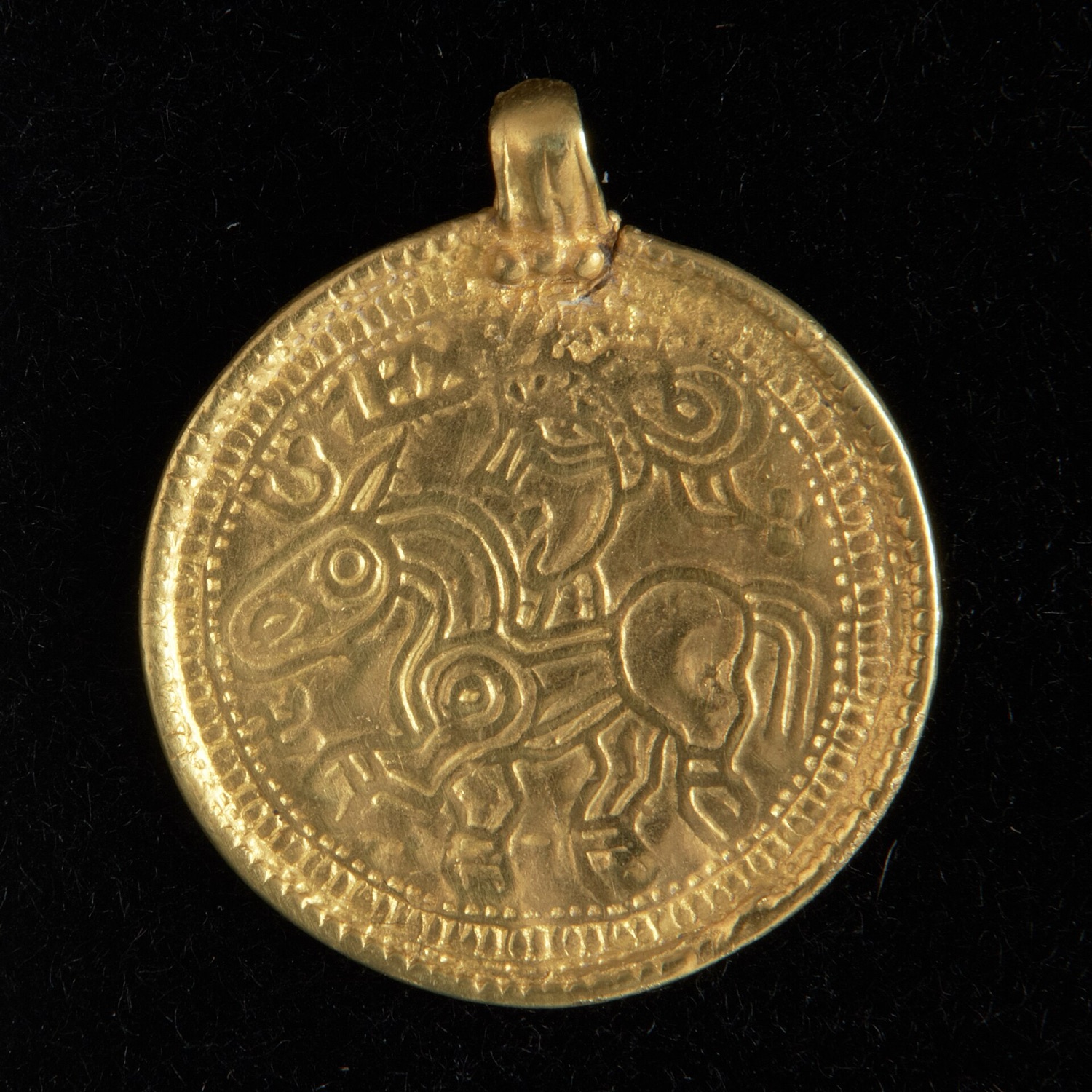
Beside the learned objects stands an enormous popular practice that rarely reaches the books. English witch bottles, stoneware jars filled with urine, nails, pins and hair and buried under hearths and thresholds in the seventeenth century to turn a witch's curse back on her, turn up in house renovations still. Horseshoes over doors, rowan crosses tied with red thread, shoes concealed in walls, hag-stones with a natural hole, the Chinese fu of red and yellow paper pasted on doors, the Thai amulet of a revered monk: every household culture has made its defences out of what was to hand. The collection at amulets.guru catalogues them by people and by purpose, so that you can find the one your own ancestors used.