IThe Pit and the Cave
In the eleventh book of the Odyssey, on Circe's instructions, Odysseus sails to the edge of the world, digs a pit a cubit square, pours libations of milk, honey, wine and water, and cuts the throats of a ram and a black ewe so that their blood runs into it. The shades of the dead gather, and only those he allows to drink the blood can recognise him and speak. His mother comes; the prophet Teiresias tells him how he will die. The nekyia, the calling up of the dead, is the oldest literary necromancy in Europe, and its logic, that the dead are weak and must be given life to speak, runs through the whole tradition.
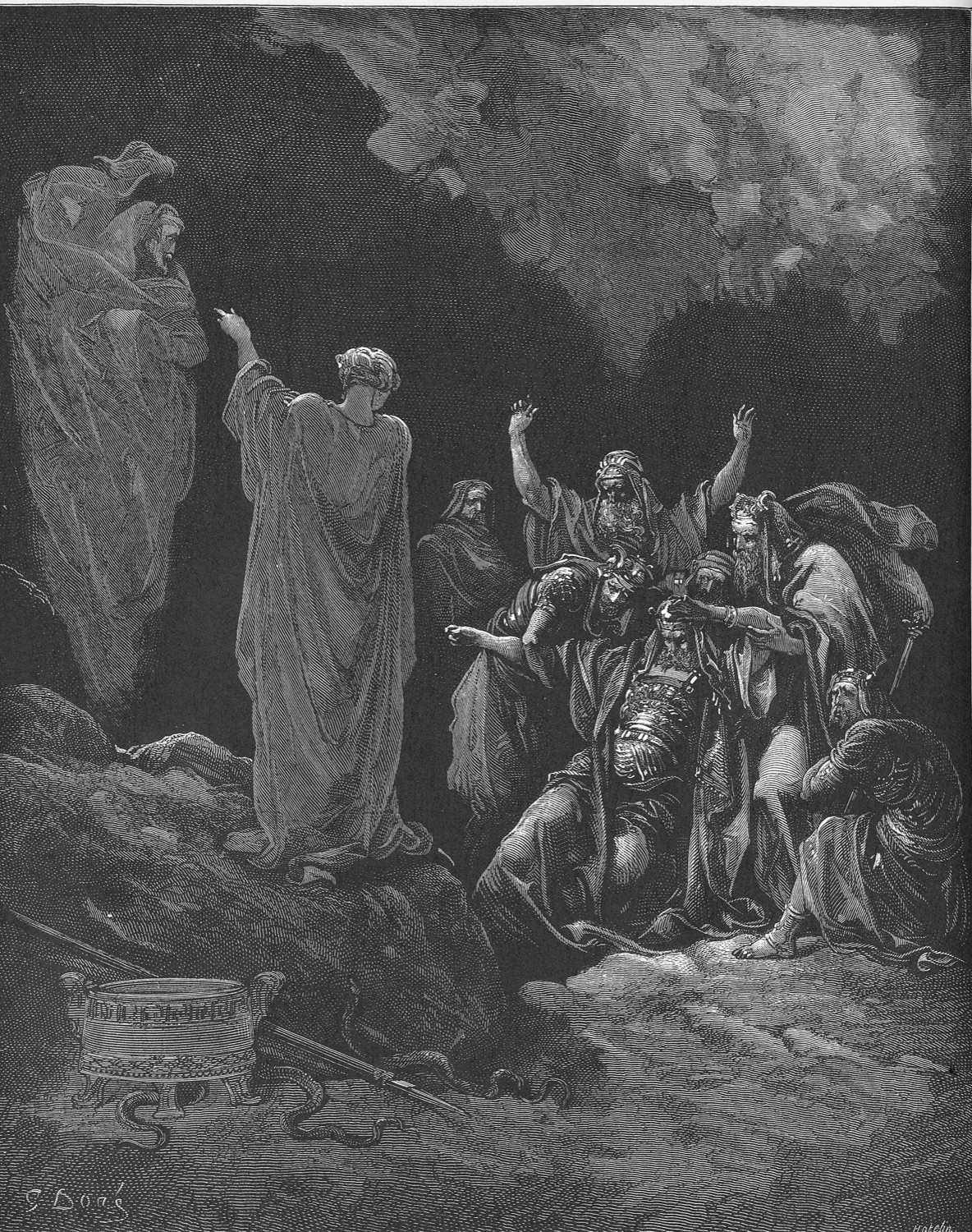
The Hebrew Bible forbids it absolutely. Deuteronomy lists among the abominations of the nations whoever consults a ghost or a familiar spirit or seeks from the dead. Yet in 1 Samuel 28 King Saul, who has expelled the mediums from the land, is abandoned by God on the eve of battle, disguises himself, and goes by night to a woman at Endor who has an ov, a ghost-pit or familiar. She calls up the prophet Samuel, who rises "as a god out of the earth", rebukes Saul and tells him that tomorrow he and his sons will be with him. The next day they are. Theologians have argued for two thousand years over whether it was really Samuel.
The Greeks had oracles of the dead, nekyomanteia. The best known is associated with the river Acheron in Epirus, where excavations in the 1950s and 60s uncovered a building the excavator identified as the sanctuary Herodotus mentions, complete with an underground vaulted hall. Later archaeologists have argued it was a fortified farmhouse. The dispute is characteristic of the subject.
IIThe Chinese Planchette
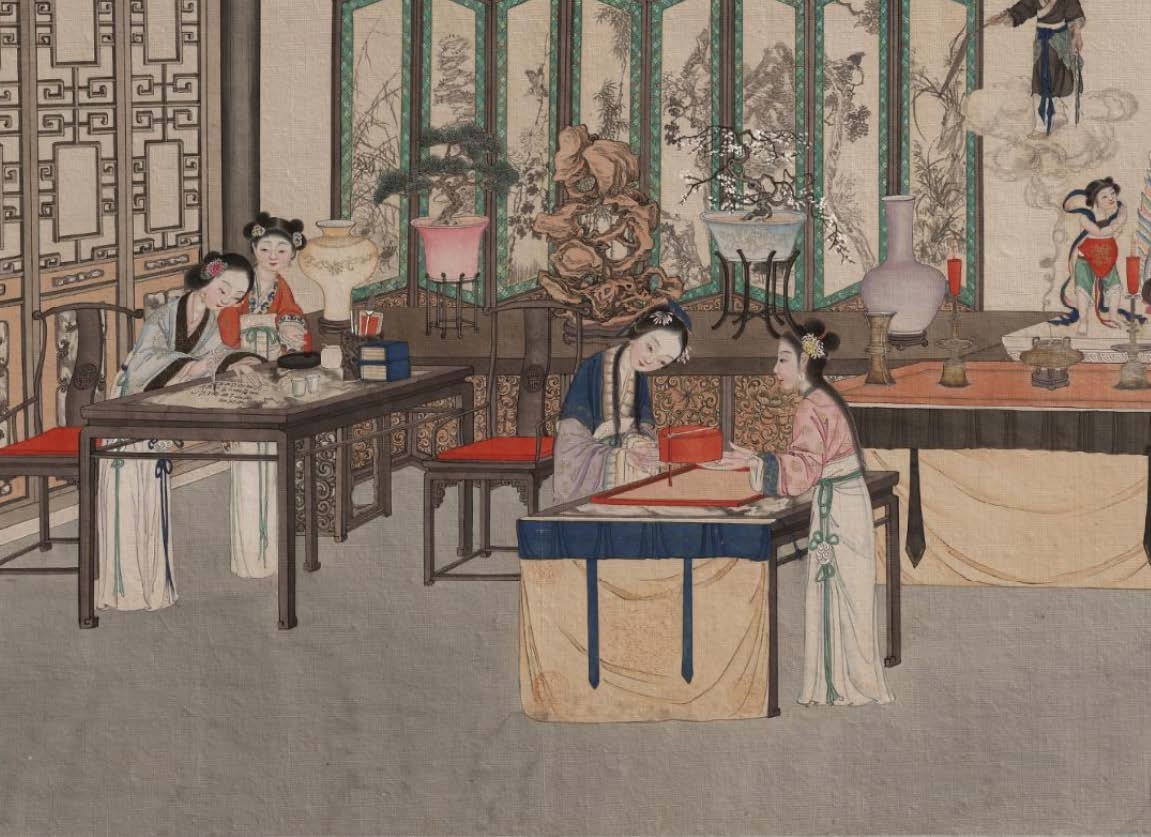
The oldest continuous tradition of instrumental spirit writing is Chinese. By the Song dynasty, and very likely earlier, fuji, supporting the stylus, was widely practised: one or two people hold a forked stick or a wooden stylus suspended over a tray of sand or incense ash, and a deity or spirit moves it to write characters, which a reader calls out and a scribe records. Poets used it to talk with the immortals, scholars to foresee examination questions, households to consult the spirit of the latrine. Whole scriptures of later Chinese popular religion were received this way, and fuji is still practised in temples in Taiwan, Malaysia and Singapore. It is, precisely, a planchette, eight hundred years before the French one.
IIISwedenborg and the Magnetisers
Emanuel Swedenborg, one of the most distinguished scientists and mining engineers of eighteenth-century Sweden, began in 1744 and 1745 to experience visions in which he was admitted to heaven and hell and conversed daily with angels and the dead. He spent the rest of his life writing them down, in Latin, in books such as Heaven and Hell of 1758. Kant wrote a satirical attack on him in 1766 while plainly unable to stop thinking about him. Swedenborg's description of a spiritual world organised by affinities, in which the dead continue their characters and occupations, became the unacknowledged geography of the Spiritualist afterlife.
The other ancestor was animal magnetism. Franz Anton Mesmer's cures in Vienna and Paris in the 1770s and 80s, by the manipulation of an invisible magnetic fluid, were investigated in 1784 by a French royal commission including Benjamin Franklin and Antoine Lavoisier, which concluded that the effects were produced by imagination. His followers discovered that magnetised subjects could fall into a somnambulistic trance in which some seemed to diagnose illness, read minds and speak with the dead. In 1847 the American trance lecturer Andrew Jackson Davis, the Poughkeepsie Seer, published The Principles of Nature, and prophesied that the spirit world would soon make open contact with this one.
IVHydesville, March 1848
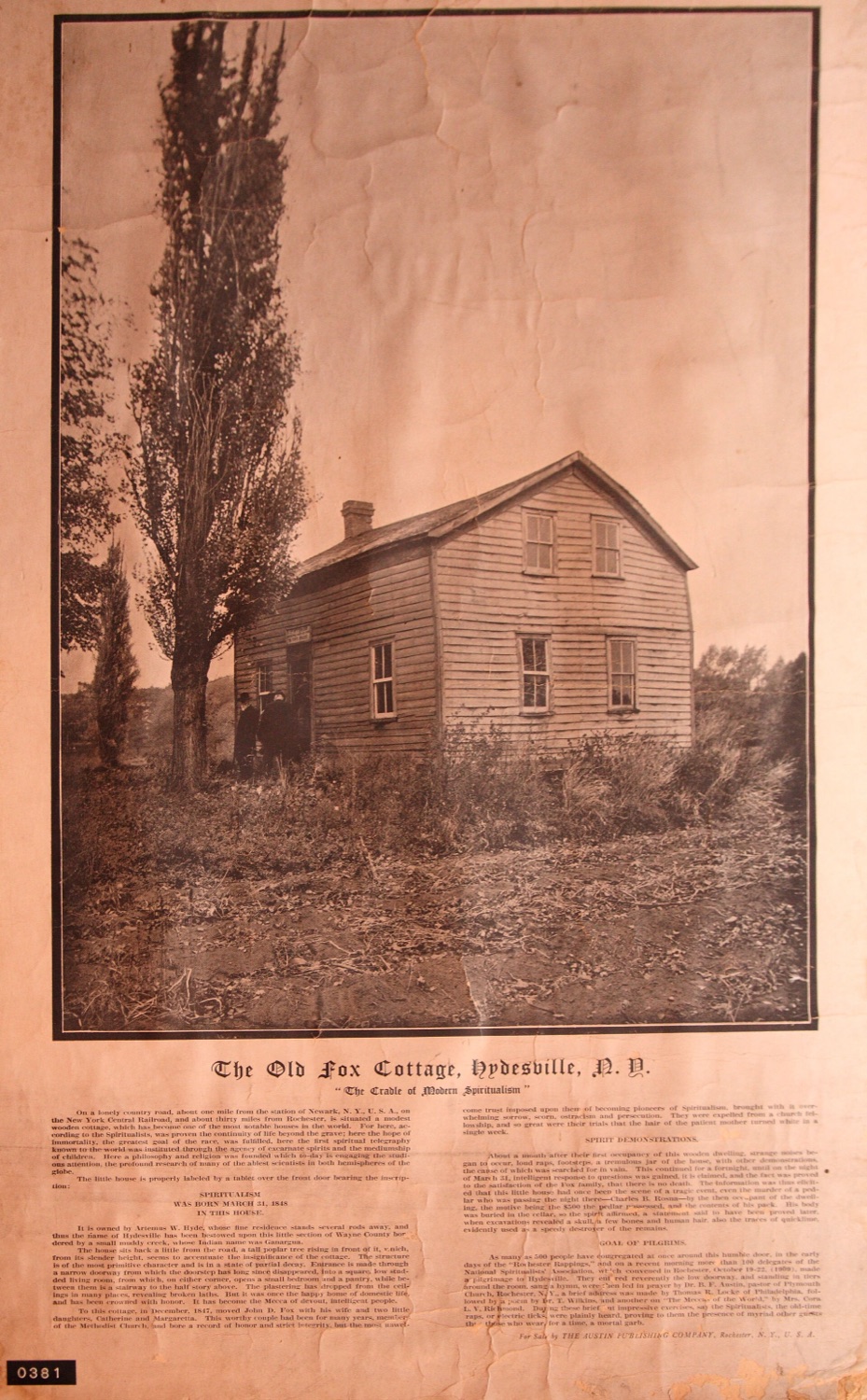
On the evening of 31 March 1848, in a small rented house in Hydesville, New York, fourteen-year-old Margaretta and eleven-year-old Kate Fox answered the knocking noises that had been disturbing the family by snapping their fingers and asking the knocks to repeat them. The knocks obliged. Asked questions, they answered by counting, then by a code, and identified themselves as a peddler murdered in the house. Neighbours came. Within two years, managed by their much older sister Leah, the girls were giving paid public demonstrations in Rochester and New York, and Modern Spiritualism had become a mass movement with hundreds of mediums, weekly newspapers and, by some contemporary estimates, millions of adherents.
On 21 October 1888, at the New York Academy of Music, Maggie Fox confessed that the rappings had begun as a prank with an apple on a string and were produced by cracking the joints of her toes, and she demonstrated the sound to the audience. A year later she retracted the confession. Both sisters died in poverty and drink within five years. The movement they began was, by then, entirely independent of them.
VTables, Faraday and the Ideomotor Effect
The Spiritualist wave reached Europe in 1852 and 1853 as table-turning. A group of sitters placed their hands lightly on a table; after a time it tilted, rotated, and rapped out answers with a leg. It became a craze in every drawing room from Paris to Berlin to London, and in the summer of 1853 Michael Faraday tested it. He placed between the sitters' hands and the table a stack of cardboard sheets held together with a weak cement, so that any sideways push by the hands would shear the sheets before it moved the table, and later a lever with a visible pointer. The indicator showed that the hands moved first, and when the sitters could see it, the table stopped moving. He published his results in The Times and the Athenaeum in the summer of 1853, and was widely abused for them.
The physiologist William Benjamin Carpenter had named the mechanism the year before: the ideomotor action, by which an expectation produces a muscular movement without any conscious intention. Chevreul had shown the same thing with the pendulum in 1833. It is the single most important fact about every instrument on this page, and it is, as the houses below would say, not a refutation of the instruments but the explanation of why they work at all.
VIThe Planchette and the Board
Within months of the table-turning craze someone in France fitted a pencil to a small basket, and then to a heart-shaped board on castors, so that the sitters' hands could write rather than rap. The planchette was mass-produced in America from the 1860s and was a bestselling parlour toy of the decade. Allan Kardec's The Spirits' Book of 1857, the foundation of Spiritism, which is still a major religion in Brazil, was received through planchettes and baskets.
The talking board removed the pencil and put the letters on the board. On 10 February 1891 the United States Patent Office granted patent 446,054 to Elijah Bond of Baltimore for a "Toy or Game" of a lettered board and a heart-shaped pointer on three felt-tipped legs, assigned to the Kennard Novelty Company, which had been selling it for a year under the name Ouija. The company's legend was that the board, asked its own name by Bond's sister-in-law Helen Peters, spelled it out and said it meant good luck. William Fuld took control of the business in the 1890s and made the board famous; Parker Brothers bought the rights in 1966, and Hasbro owns them now.
The board's great literary medium was Pearl Curran of St Louis, through whom, from 1913, a personality calling herself Patience Worth, a seventeenth-century Englishwoman, dictated poems and novels in an archaic English that philologists could not place. Jane Roberts's Seth began on a Ouija board in 1963. The story is told in full on the houses below.