IWhat Magic Is, and Is Not
Every definition of magic has been written by someone trying to exclude someone else. For the early Church it was the religion of demons. For the Protestant reformers it was the Mass. For the anthropologist James Frazer, whose Golden Bough of 1890 shaped a century of thought, it was a primitive and mistaken science, operating by two laws: the law of similarity, that like produces like, and the law of contagion, that things once in contact continue to act on each other. Frazer's sympathetic magic is still a useful description of a great deal of folk practice, though his evolutionary scheme of magic, religion and science has long been abandoned.
This chapter is about a narrower thing: the learned ritual magic of the grimoire tradition, in which a trained operator uses written rituals, divine names, seals and prepared instruments to evoke or invoke spirits, angels or powers, or to draw down the influence of the heavens. It is literate, bookish, often clerical, and has a continuous documented history from the papyri of Roman Egypt to the present day.
IIThe Papyri and Theurgy
The Greek Magical Papyri, a collection of working manuscripts bought in Egypt in the nineteenth century and dating from the second century BC to the fifth century AD, are the closest thing that survives to a Roman magician's notebook. They mix Egyptian, Greek, Jewish and Babylonian divinities without embarrassment, give recipes for love charms, curse tablets, dream oracles and invisibility, and include the ritual of the Headless One, later adapted by the Golden Dawn and Crowley as the Bornless Ritual. Their voces magicae, strings of unintelligible names like ablanathanalba, are the ancestors of every barbarous word in the later grimoires.
At the other end of the social scale was theurgy, god-working, the ritual practice of late Neoplatonist philosophers. Iamblichus of Chalcis, around AD 300, defended it in On the Mysteries against Porphyry's objection that the gods could not be compelled by rites. The rites, Iamblichus answered, do not compel the gods but raise the soul to them, using the tokens the gods themselves have sown in nature. The distinction between low goetia and high theurgy, between compelling spirits and ascending to the divine, runs through all subsequent learned magic.
IIIThe Grimoires
A grimoire, from the French for grammar, is a book of magic, and the medieval and early modern tradition is best understood as a family of texts copied, adapted and pseudonymously attributed across several centuries. Solomon, whom Jewish legend credited with a ring that commanded demons, is their most common patron; Moses, Enoch, Pope Honorius and Albertus Magnus are others.
| Text | Date | Content |
|---|---|---|
| Greek Magical Papyri | 2nd c. BC – 5th c. AD, Egypt | Working notebooks of Greco-Egyptian magicians: invocations, love spells, divination, the Headless One. |
| Sefer ha-Razim | Late antiquity | Jewish book of the angels of the seven heavens and how to command them. |
| Picatrix (Ghayat al-Hakim) | Arabic c. 10th–11th c.; Castilian 1256, then Latin | The encyclopedia of astral magic: planetary images, prayers and incenses. |
| Ars Notoria | 13th c. | The notory art: prayers and figures for the instant acquisition of the liberal arts. |
| Sworn Book of Honorius | 13th–14th c. | A ritual for the beatific vision, attributed to a council of magicians. |
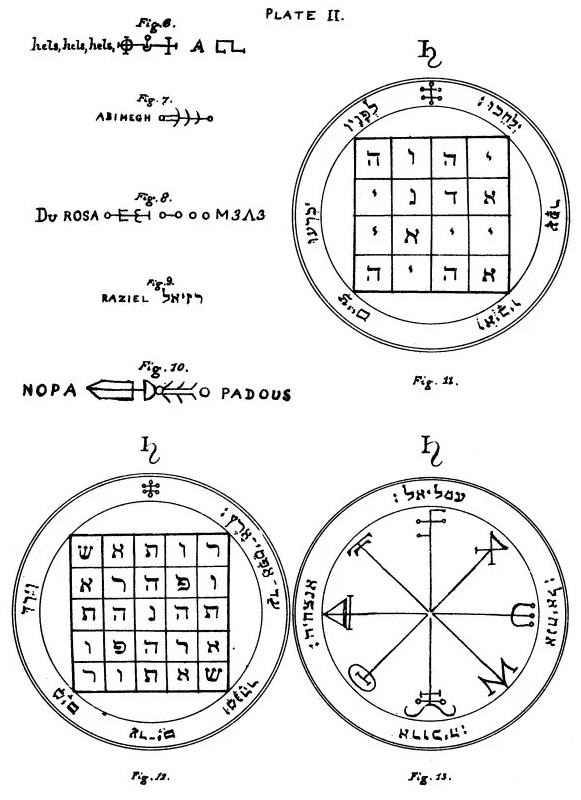
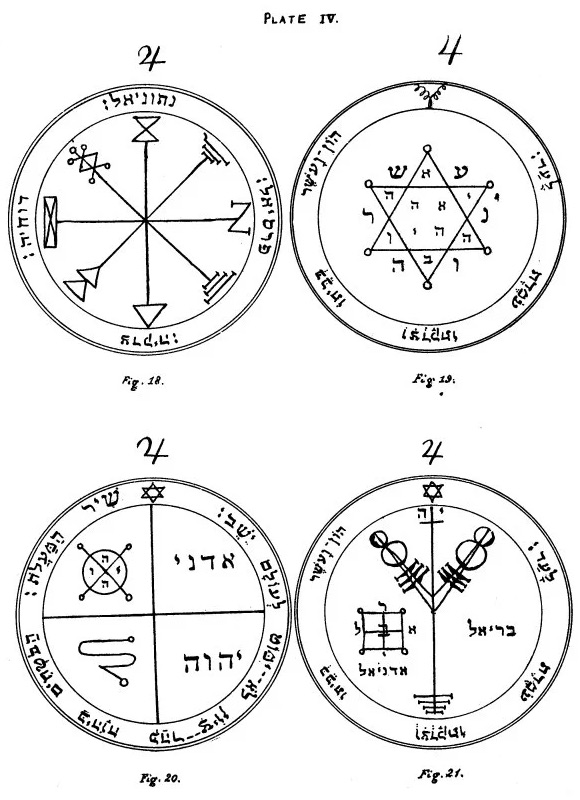
| Key of Solomon (Clavicula Salomonis) | 15th–16th c., Italian and Latin | Pentacles, purifications, the circle; edited by Mathers in 1888. |
| Three Books of Occult Philosophy | Agrippa, 1533 | The Renaissance synthesis: elemental, celestial and intellectual magic. |
| Heptameron | Attributed to Peter of Abano, printed 1559 | A compact manual of angelic evocation by days and hours. |
| The Lesser Key of Solomon (Lemegeton) | 17th c. | Five books; the first, the Goetia, lists seventy-two spirits with their seals. |
| Grimorium Verum, Grand Grimoire | 18th c., France | Cheap chapbook grimoires of pacts and treasure-hunting. |
| The Book of Abramelin | German MS; French version edited by Mathers 1898 | Eighteen months of retreat to obtain the knowledge and conversation of the Holy Guardian Angel. |
| The Magus | Francis Barrett, 1801 | A compilation from Agrippa and others that revived English ceremonial magic. |
The typical operation of the Solomonic tradition runs as follows. The operator purifies himself by fasting, prayer and bathing for a set number of days. He prepares instruments, a knife, a wand, robes, a parchment, according to exact prescriptions and in the correct planetary hour. He draws a circle inscribed with divine names in which he stands protected, and a triangle outside it into which the spirit is to be constrained. He recites conjurations naming God by many names and binding the spirit by the seal drawn for it. When the spirit appears he gives his charge, and then licenses it to depart. The whole is Christian in its language and explicitly depends on the power of God over the demons; the medieval Church nonetheless regarded it as idolatry.
IVAgrippa and Dee
Heinrich Cornelius Agrippa of Nettesheim drafted De occulta philosophia around 1510 and published the full three books in 1533. Its structure is the Renaissance cosmos itself. The first book treats the elemental world and natural magic: the occult virtues of stones, plants and animals. The second treats the celestial world and mathematical magic: number, the magic squares of the planets, astrological images. The third treats the intellectual world and ceremonial magic: the divine names, the angels, Cabala and the soul's ascent. Every later Western magical system draws on it. The spurious Fourth Book, published after his death, is not his.
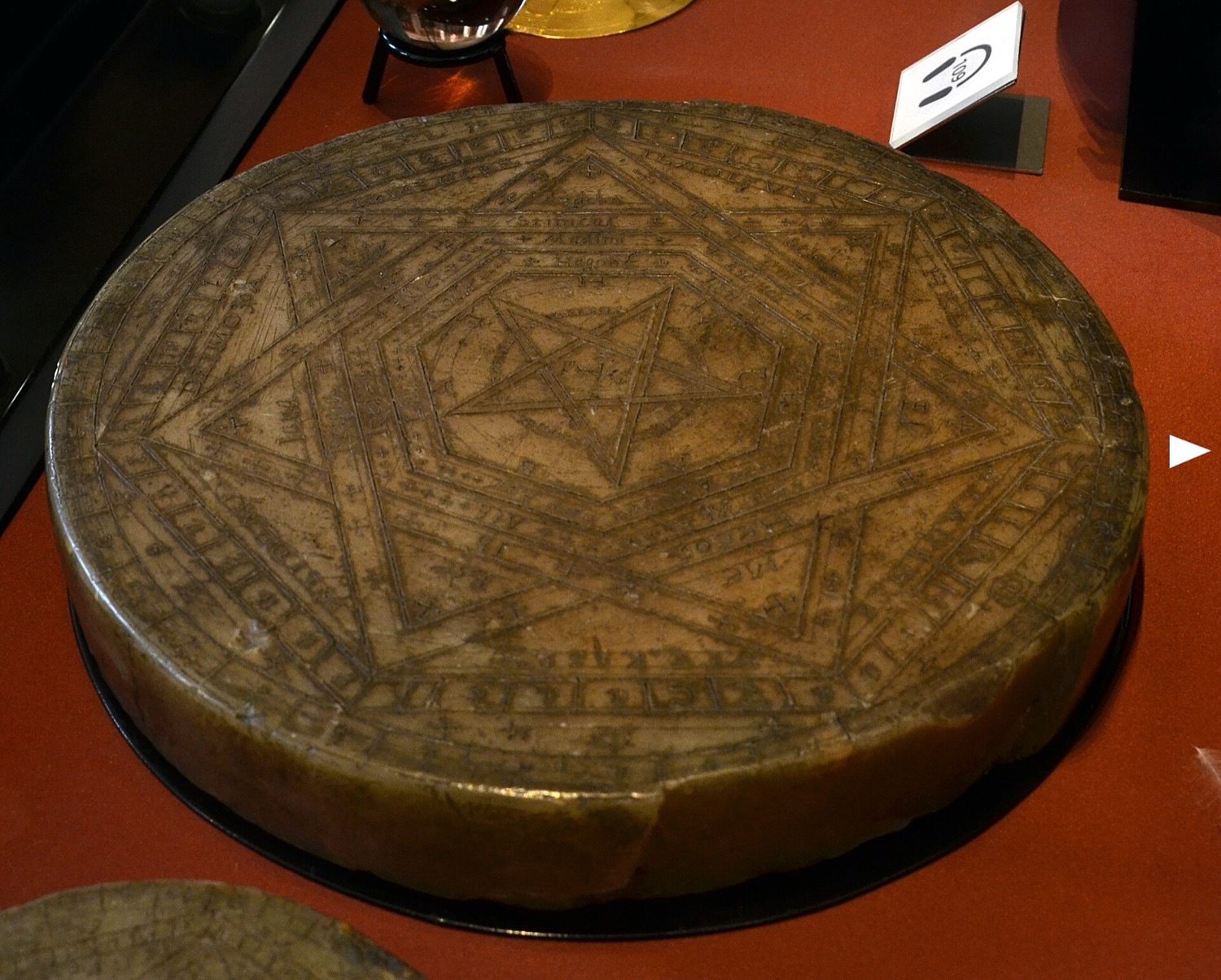
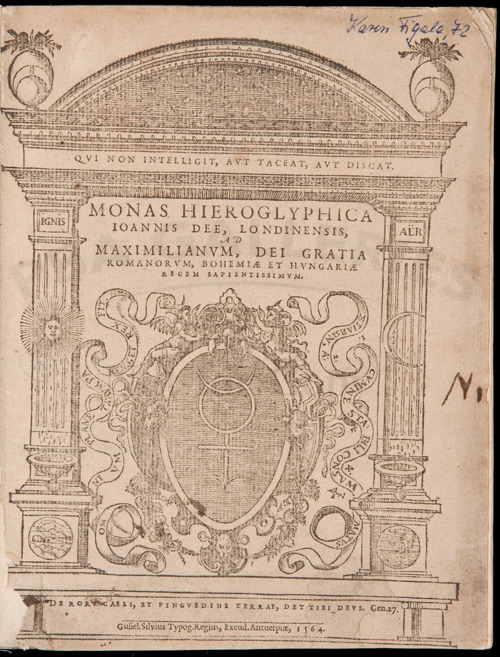
John Dee, mathematician, adviser to Elizabeth I and owner of the largest private library in England, spent the years from 1582 in conversation with angels through a scryer, Edward Kelley, who gazed into a shewstone and reported what he saw and heard. The sessions, recorded in Dee's meticulous diaries, produced the Enochian language with its own alphabet and grammar, the forty-eight Angelic Calls, the great tables of letters and the Sigillum Dei Aemeth, before ending in 1587 with the angels' instruction that the two men share their wives. Dee's obsidian mirror, his crystal and his wax seals are in the British Museum.
VLévi and the Golden Dawn
The modern magical revival begins with a defrocked seminarian. Alphonse Louis Constant, writing as Éliphas Lévi, published Dogme et rituel de la haute magie in 1854–56. He redescribed magic as the science of the astral light, a universal medium of imagination and will that the adept could direct, and he supplied the drawing of Baphomet, the winged goat-headed androgyne, that every horror film has borrowed since. He tied the tarot to the Hebrew letters, and the whole Hermetic Qabalah grew from that.
The Hermetic Order of the Golden Dawn was founded in London in 1888 by three Freemasons, William Wynn Westcott, Samuel Liddell MacGregor Mathers and William Robert Woodman, on the basis of a cipher manuscript whose provenance was almost certainly fabricated. In little more than a decade it assembled the most complete synthesis of Western magic ever made: grades of initiation mapped on the Tree, the Lesser Banishing Ritual of the Pentagram, the invocation of the god-forms, Enochian magic, geomancy, astrology, tarot and scrying, taught to members who included W. B. Yeats, Florence Farr, Arthur Machen and Arthur Edward Waite. It split in 1900 in a quarrel between Mathers and the London temple, and its offshoots have multiplied ever since.
VICrowley, Spare and Chaos
Aleister Crowley joined the Golden Dawn in 1898. In Cairo in April 1904 he received, by his account from a praeter-human intelligence named Aiwass, the three chapters of The Book of the Law, whose law is Do what thou wilt shall be the whole of the Law and Love is the law, love under will. Thelema, the religion he built on it, redefined magick with a k as the Science and Art of causing Change to occur in conformity with Will, and his Magick in Theory and Practice of 1929 is the most influential manual of the twentieth century. He led the Ordo Templi Orientis from 1925 and died in Hastings in 1947.
Austin Osman Spare, a brilliant draughtsman who passed briefly through Crowley's circle, developed a method of his own. Write a desire as a sentence, strike out the repeated letters, and compose the rest into a single abstract glyph, the sigil; then charge it in a state of vacant or ecstatic mind and forget it, so that the desire passes into the unconscious without the interference of conscious longing. Chaos magic, formalised by Peter Carroll's Liber Null of 1978 and the Illuminates of Thanateros, took Spare's sigils and a single principle, that belief is a tool to be adopted and discarded for its effects, and made them the basis of the most influential magical movement of the late twentieth century.
VIIA Maker's Note
I cut talismans and etch seals for people who practise this tradition, and I read the grimoires the way a joiner reads an old pattern book: for what they specify. What they specify, again and again, is exactness. The right metal, the right hour, the name spelt one way and not another, the circle unbroken. Whatever one thinks happens in the triangle, the discipline required of the operator is real, and the objects demanded are among the most precisely described in any literature. That is why the houses below can make them.