ICicero's Two Kinds
In 44 BC, in the months after Caesar's murder, Marcus Tullius Cicero finished De divinatione, a dialogue in two books between himself and his brother Quintus. Quintus defends divination with the Stoic arguments; Marcus, himself a member of the college of augurs, demolishes them. The book is still the best introduction to the subject, because Quintus draws the distinction every later writer has used.
Natural divination requires no technique. The soul, freed from the body in sleep, frenzy or trance, perceives the future directly: dreams, oracles, prophecy, the Sibyl. Artificial divination is a learned skill of interpreting signs: the entrails of victims, the flight of birds, lightning, lots, the stars. Everything on this page falls on one side or the other, and the mediums and channels of later chapters are simply natural divination under new names.
Cicero's own verdict was that divination was superstition, but that the state religion which practised it should be maintained for the sake of public order. That, too, has had a long history.
IIShang Bones and the Babylonian Liver
The oldest substantial body of Chinese writing is divinatory. The kings of the late Shang dynasty, roughly 1250 to 1050 BC, put questions to their ancestors by heating the shoulder blades of oxen and the undershells of turtles until they cracked, reading the pattern of the cracks, and then carving the question, and sometimes the answer and the outcome, into the bone. Some one hundred and fifty thousand of these oracle bones have been recovered since the first were identified in 1899, many from druggists who were grinding them as "dragon bones" for medicine. Will it rain? Will the royal consort's childbirth be good? Should the king attack the Tufang? They are the foundation of Chinese palaeography.
In Mesopotamia the equivalent science was extispicy, and especially hepatoscopy, the reading of the liver of a sacrificed sheep. The bārû, the diviner, examined the liver's lobes, marks and irregularities against a great written series of omens, and clay models of livers inscribed with their meanings survive from Babylon and Mari. The Etruscans inherited or developed the same art; the bronze Liver of Piacenza, divided into regions each labelled with the name of a god, is its most famous object, and the Roman haruspices practised it into the Christian era.
IIIThe Book of Changes
The Zhou yi, the core of the I Ching, was compiled in the Western Zhou period, probably around the ninth century BC, as a diviner's manual. It consists of sixty-four hexagrams, figures of six stacked lines each either broken or unbroken, with a name, a judgement and a statement for each line. Tradition credits the hexagrams to King Wen of Zhou and the line texts to the Duke of Zhou; the philosophical commentaries called the Ten Wings, which turned a divination manual into a Confucian classic, were attributed to Confucius and date in fact from the Warring States period and after.
The hexagram is generated by a random procedure. The classical method uses fifty stalks of yarrow, divided and counted in a long sequence that yields each line with unequal probabilities; the later three-coin method is quicker and changes the odds. Lines that come up as "old" are changing lines, and they transform the hexagram into a second one, so that every reading describes a situation and its movement. When Joachim Bouvet sent Gottfried Leibniz a diagram of the hexagrams in 1701, Leibniz saw in them his own binary arithmetic. Richard Wilhelm's German translation of 1924, put into English by Cary Baynes in 1950 with a foreword by Jung, is the edition through which the West came to know it.
IVThe Oracle at Delphi
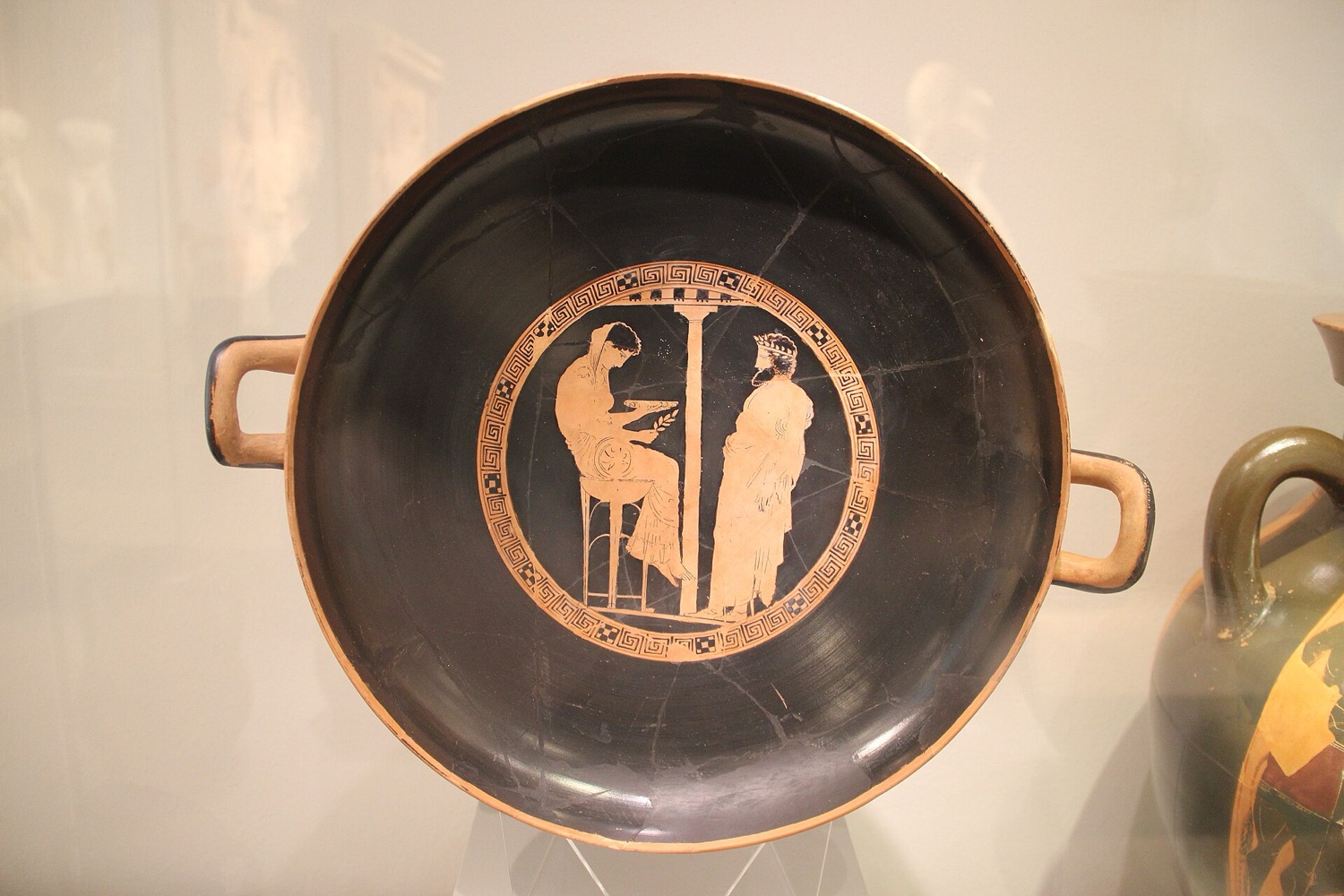
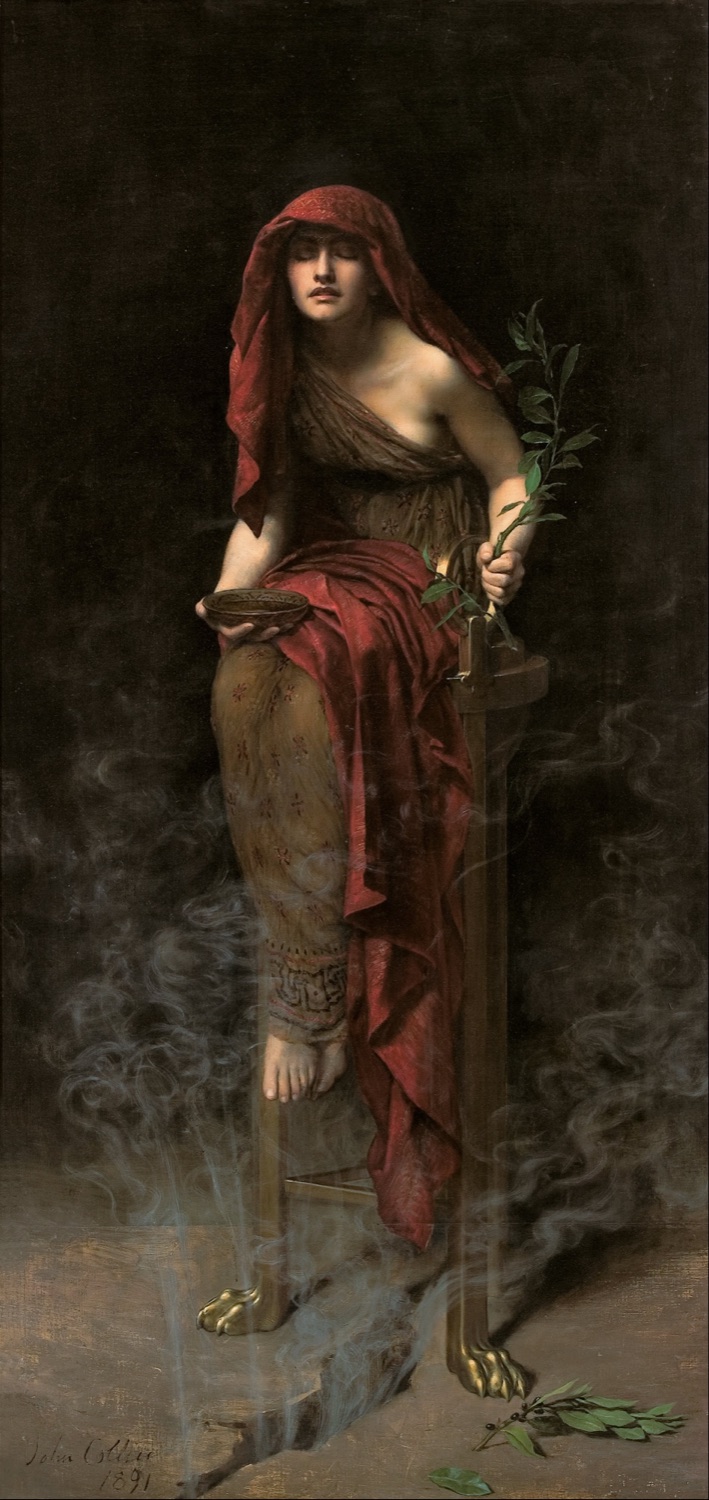
For a thousand years the most important religious site in the Greek world was a temple on the slopes of Mount Parnassus where a woman, the Pythia, sat on a tripod over a cleft in the rock and, possessed by Apollo, answered questions. Cities consulted her before founding colonies, going to war or passing laws; the most famous answer in history, reported by Herodotus, was given to Croesus of Lydia, who was told that if he attacked Persia he would destroy a great empire. He did; it was his own.
Plutarch, who served as a priest at Delphi around AD 100, reported that the Pythia's inspiration was associated with a sweet-smelling vapour rising from the ground. For most of the twentieth century scholars dismissed this, since the French excavators found no chasm. In 2001 a geologist, Jelle de Boer, and an archaeologist, John Hale, reported that two geological faults cross under the temple and that the spring waters carry traces of light hydrocarbons including ethylene, which in low doses produces euphoria and a trance-like state. Their interpretation is still disputed. The oracle fell silent in the late fourth century AD, when the Christian emperors closed the pagan temples.
VGeomancy and the Sixteen Figures
Arabic ʿilm al-raml, the science of the sand, is a method of generating answers from random marks. The diviner makes four rows of dots in sand or on paper without counting, reduces each row to one point or two by parity, and so produces a figure of four lines. Sixteen such figures are possible, each with a Latin name in the European tradition, Via, Populus, Puer, Puella, Fortuna Major, Carcer and the rest, and four generated figures are combined by a fixed procedure into a shield chart of sixteen from which the judgement is read. It entered Latin in the twelfth century and was one of the most practised divinations of the Middle Ages; Robert Fludd wrote on it and the Golden Dawn taught it.
The same sixteen-fold binary structure underlies the Ifá divination of the Yoruba of West Africa, with its sixteen principal odù and two hundred and fifty-six combinations, each with a corpus of verses memorised by the priest, and the sikidy of Madagascar. Most scholars think these systems are historically related to Arabic geomancy across the trade routes of the Sahara and the Indian Ocean; which way the influence ran is still debated. Ifá was proclaimed a Masterpiece of the Oral and Intangible Heritage of Humanity by UNESCO in 2005.
VILots, Runes and the Book Opened at Random
Cleromancy, the casting of lots, is the most widespread of all methods and is sanctioned in the Hebrew Bible, where the priestly Urim and Thummim answered yes or no and the land of Canaan was divided by lot. Tacitus, in Germania of AD 98, describes the Germanic tribes cutting a branch from a fruit tree into slips, marking them with signs, scattering them on a white cloth and reading three chosen at random. He does not say the signs were runes, and the runic alphabet is not attested until the second century. Modern rune divination, with its meanings for each of the twenty-four letters of the elder futhark and its famous blank rune, is essentially a creation of the twentieth century, popularised by Ralph Blum's Book of Runes in 1982.
Bibliomancy is older. The Romans practised sortes Vergilianae, opening Virgil at random; the emperor Hadrian is said to have learned of his accession that way. Christians did the same with the Gospels, Muslims with the Qur'an and the poetry of Hafez, and Augustine's conversion in the garden at Milan in 386 came from opening the Epistle to the Romans at the words take up and read.
VIIMirrors, Pendulums and the Hand
The methods of scrying, gazing into a reflective or clear surface until images appear, and of the pendulum and the dowsing rod, are treated in detail in the chapters on magic and psychical research, and at length by the houses below. Their mechanisms are well understood: the uniform visual field that makes the eye generate its own imagery, and the involuntary muscle movement that Chevreul demonstrated with a pendulum in 1833. Understanding the mechanism has never stopped anyone using them, and the instruments made for them are among the most beautiful in the tradition.
Chiromancy, palmistry, is mentioned in Aristotle's History of Animals, flourished in medieval manuscripts and early printed books, and had its modern revival in the celebrity readings of William John Warner, who called himself Cheiro, in the 1890s.
VIIIThe Table of the -Mancies
The Greek suffix -manteia, prophecy, gave European learning a way to name every method, real or imagined. Many of these terms were coined by Renaissance encyclopedists who never saw the practice, and some practices were never more than entries in such lists. These are the ones with a documented history.
| Name | Divination by |
|---|---|
| Aeromancy | air and atmospheric phenomena |
| Alectryomancy | a cockerel pecking grain from among letters |
| Aleuromancy | messages baked in flour |
| Astragalomancy | knucklebones or dice |
| Austromancy | the winds |
| Belomancy | arrows drawn or shot |
| Bibliomancy | a book opened at random |
| Capnomancy | the movement of smoke |
| Cartomancy | playing cards |
| Catoptromancy | mirrors |
| Ceromancy | molten wax poured into water |
| Chiromancy | the lines of the hand |
| Cleromancy | the casting of lots |
| Crithomancy | grain and the crust of bread |
| Crystallomancy | a crystal or glass sphere |
| Dactylomancy | a suspended ring |
| Extispicy | the entrails of a sacrificed animal |
| Geomancy | sixteen figures generated from marks in earth or on paper |
| Hepatoscopy | the liver of a sacrificed sheep |
| Hydromancy | water |
| Lecanomancy | oil on water in a basin |
| Lithomancy | stones cast or gazed into |
| Molybdomancy | molten lead dropped into water |
| Necromancy | the dead |
| Oinomancy | wine and its lees |
| Oneiromancy | dreams |
| Ornithomancy | the flight and cries of birds |
| Pyromancy | fire |
| Rhabdomancy | rods and wands, including dowsing |
| Scapulimancy | cracks in a heated shoulder blade |
| Sciomancy | shadows, or the shades of the dead |
| Sortes | verses chosen at random from a sacred or classic text |
| Tasseomancy | tea leaves or coffee grounds |
| Tephramancy | ashes |