IThe Figure
Thoth was the ibis-headed scribe of the Egyptian gods, the inventor of writing and the keeper of the divine speech. When the Greeks settled in Egypt after Alexander they identified him with their own Hermes, messenger and patron of interpretation, and at Hermopolis, Thoth's cult centre, the title megistos kai megistos theos megas, greatest and greatest great god, attached itself to the combined figure. Hermes Trismegistos, Thrice-Great Hermes, is the Greek abridgement.
By the Roman period he had become something more useful than a god: a human sage of immense antiquity, a contemporary or predecessor of Moses, who had received a revelation of the nature of God, the cosmos and the soul and written it down. The early Christian writers Lactantius and Augustine took him seriously, the first as a pagan prophet of Christ and the second as a dangerous idolater, and both assumed he was very old. That assumption would last thirteen hundred years.
IIThe Hermetica
The body of writing attributed to Hermes divides into two very different groups, and the confusion between them causes most of the nonsense written about the subject.
The technical Hermetica are practical works on astrology, alchemy, magic and the medical properties of plants and stones: texts like the Cyranides and the astrological Salmeschiniaka. They are scattered, fragmentary, and circulated from the Hellenistic period onward.
The philosophical Hermetica are something else: a set of dialogues and treatises in Greek, most likely written in Egypt in the second and third centuries AD, concerned with the nature of God, the creation of the world by the divine Mind, the fall of the soul into the body and its return, and the rebirth of the initiate. The chief collection is the Corpus Hermeticum, seventeen treatises assembled by Byzantine editors, of which the first, the Poimandres, is the most famous: Hermes in a trance meets Poimandres, the Mind of Sovereignty, who shows him the creation of the world from light and the descent of the archetypal Man through the planetary spheres. To this add the Asclepius, which survives in Latin and contains the famous and troubling passage on the Egyptian priests who drew down the souls of daemons into statues, and the Stobaean fragments preserved by a fifth-century anthologist.
In 1945 a jar dug up near Nag Hammadi in Upper Egypt contained, among the Gnostic codices, three Hermetic texts in Coptic: The Discourse on the Eighth and Ninth, a Prayer of Thanksgiving and part of the Asclepius. They proved that Hermetic groups were practising, not only reading, in the same world as the Gnostics.
IIIThe Emerald Tablet
The most quoted Hermetic text is not in the Corpus at all. The Tabula Smaragdina is a short set of cryptic precepts said to have been found inscribed on emerald in the tomb of Hermes. Its earliest known version is Arabic, embedded in the Sirr al-Khaliqa, the Book of the Secret of Creation, attributed to Balinas, that is, Apollonius of Tyana, and dated to somewhere between the late eighth and the early tenth century. It passed into Latin in the twelfth century and became the founding charter of European alchemy.
It is true, without falsehood, certain and most true. That which is below is like that which is above, and that which is above is like that which is below, to accomplish the miracles of the one thing. And as all things were from the one, by the mediation of the one, so all things were born from this one thing by adaptation.From the Latin vulgate of the Emerald Tablet
Note what it actually says. As above, so below is a paraphrase, and the original is not a slogan about the universe mirroring itself but an instruction: the likeness of above and below exists to accomplish the miracles of the one thing, which the alchemists read as the preparation of the philosophers' stone. Newton translated it himself.
And note what it is not. The Kybalion, published in Chicago in 1908 by "Three Initiates" and almost certainly written by the New Thought author William Walker Atkinson, presents seven "Hermetic principles" as ancient teaching. It is a twentieth-century self-help book with no connection to any Hermetic text, and it is the book from which most people now think they know what Hermeticism is.
IVFlorence, 1463
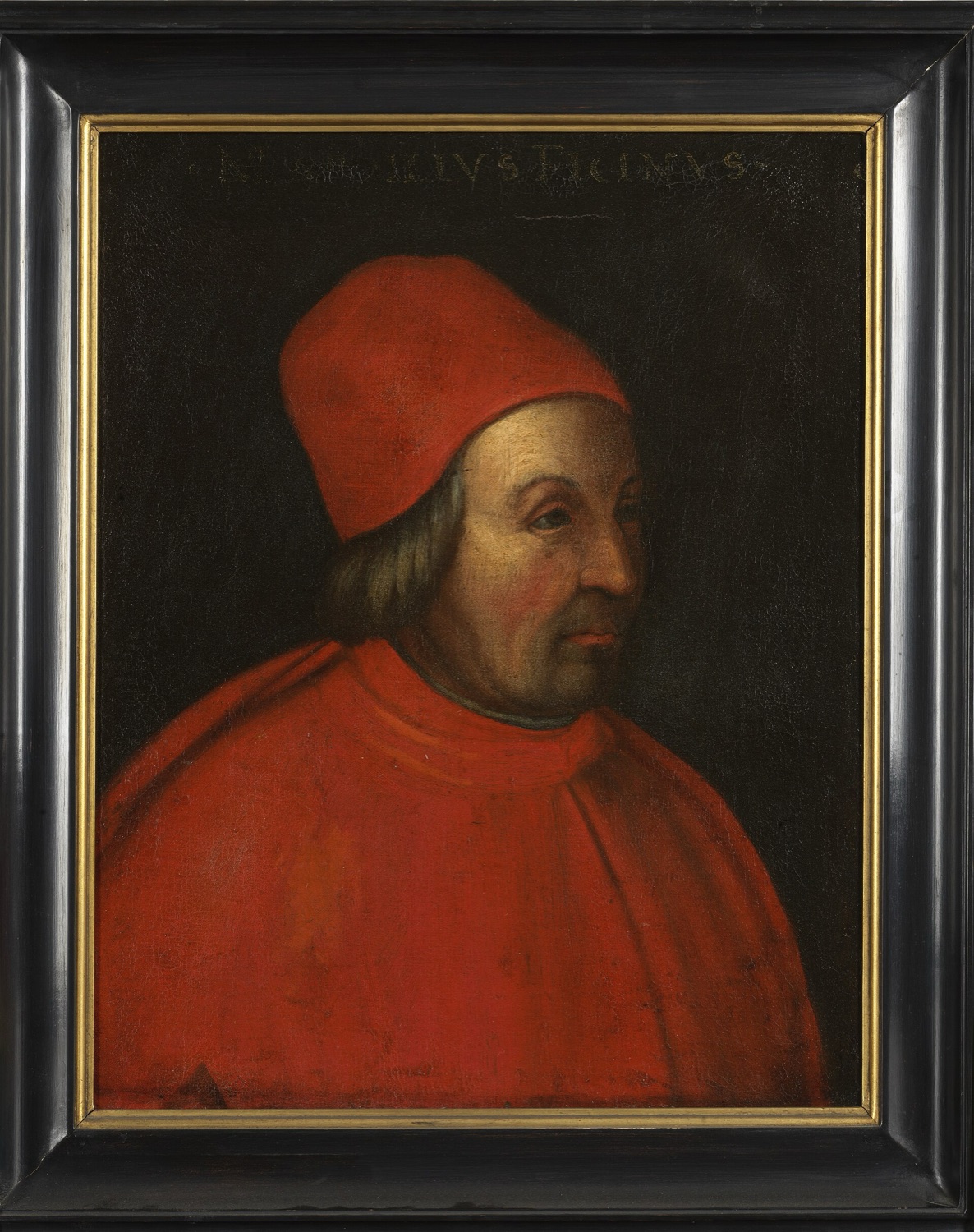
A manuscript of fourteen treatises of the Corpus Hermeticum reached Florence around 1460, brought from Macedonia by a monk working for Cosimo de' Medici. Cosimo had already commissioned Marsilio Ficino to translate the whole of Plato, and he was old and wanted to read Hermes before he died. Ficino put Plato aside and produced the Latin Pimander in 1463. It was printed in 1471 and ran through sixteen editions before the end of the next century.
The consequence was enormous, because Ficino and everyone who read him believed Hermes to be the fountainhead of a prisca theologia, an ancient theology descending from Hermes through Orpheus and Pythagoras to Plato, which had anticipated Christianity. If that were true, then the magic of the Asclepius, the drawing of celestial influence into images and statues, was part of the oldest and holiest wisdom in the world. Ficino's own De vita coelitus comparanda of 1489 is a careful manual of exactly that: how to draw down the favour of the stars through music, scent, colour and talismans without falling into demon-worship. The Renaissance magus was born in that book.
VLondon, 1614
Isaac Casaubon was the greatest Greek scholar of his age, a Huguenot living in England under the protection of James I, and in 1614 he published a massive refutation of the Catholic historian Baronius. In the course of it he looked hard at the Corpus Hermeticum and noticed that its Greek was the Greek of the Roman empire, not of Pharaonic Egypt; that it quoted Plato and echoed the Gospel of John; that it named sculptors like Phidias; and that no Greek author before the Christian era ever mentioned it. His conclusion was that the Hermetica were late forgeries, written after Christ by people who had read Plato and the Christians.
He was substantially right about the date. Modern scholarship puts the philosophical Hermetica in the second and third centuries AD. But he was probably wrong that they were Christian-influenced forgeries: the texts are now read as genuine products of Greco-Egyptian religious circles, drawing on real Egyptian as well as Greek ideas. Frances Yates, in Giordano Bruno and the Hermetic Tradition of 1964, argued that Casaubon's redating quietly ended the Renaissance magical worldview by removing its foundation. That thesis has been heavily qualified since, but no single footnote in the history of scholarship did more damage to a living tradition.
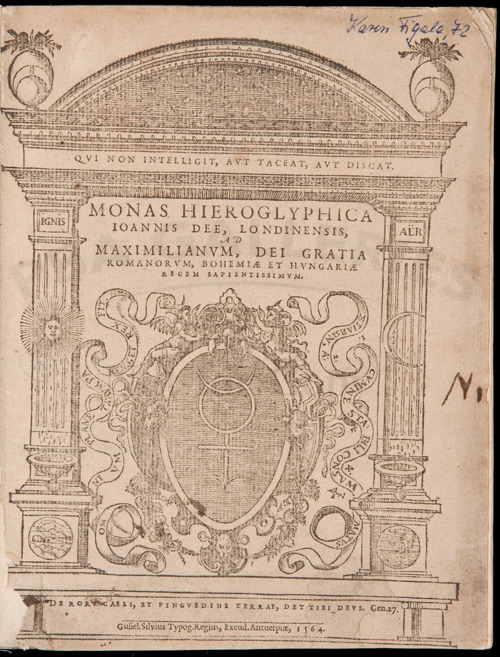
The Hermetic texts went on being read, by the Rosicrucians, by Newton, by the Golden Dawn and by everyone after. They simply stopped being thought of as older than Moses.
VIWhat the Hermetica Teach
Stripped of its later accretions, the philosophical Hermetic teaching is a religious philosophy of salvation through knowledge. God is Mind and Light and cannot be named. The cosmos is God's image, alive and beautiful. The human being is doubly made, with a mortal body and an immortal essential Man, and the soul fell into matter through love of its own reflection in nature. Salvation is gnosis: the soul ascends back through the seven planetary spheres, leaving at each the vice it acquired there, until it reaches the Eighth and the Ninth and becomes God. Treatise XIII describes the rebirth of the initiate Tat in terms that read like an initiation ritual, and very likely were one.
Unlike most Gnostic writing, the Hermetica do not hate the world. The cosmos is the second god, and to know it is to begin to know the first. That single difference is what made them usable to Renaissance Christians, and why the magus could love nature while trying to rise above it.